Non-Stick Fiber Physics & Certified Molten Splash Protection.
From molten aluminum (~750°C) to incandescent iron and steel (1400°C+) and corrosive cryolite baths — standard FR garments fail within seconds in metallurgical operations. Explore our non-stick MARLAN PLUS systems certified to EN ISO 9185 (Classes D3 / E3) and proven at 1,050 g extreme aluminum pour.

Why Does Molten Metal Burn Through Standard FR Clothing?
Temperature alone does not define foundry risk. Melt viscosity, reactive oxide films, latent heat of fusion, and chemical adhesion to synthetic fibers dictate burn severity.
Molten Aluminum Splash
Despite melting at a lower temperature than iron, liquid aluminum is the deadliest molten metal for textiles. It oxidizes instantly in air into a sticky alumina film that clings to synthetic fibers, burns through, and contacts skin.
Molten Iron & Steel Splash
Extreme thermal energy, convective shock, and intense infrared wavelengths. Flame resistance alone is insufficient — the fabric must immediately shed molten iron droplets and keep rear PVC skin-sensor temperature rise below the damage threshold.
Molten Cryolite Bath
Used in primary aluminum electrolysis cells, molten cryolite (Na₃AlF₆) combines extreme fluidity and chemical corrosivity, melting through standard protective weaves in seconds and requiring dedicated accredited lab verification.
Why Must Aramid Never Be Used on the Outer Shell?
Aramid fibers (Nomex®, Kevlar®) excel against electric arc flash and flash fire, yet can cause catastrophic injuries when used as an outer shell against molten metal. Molten metal chemically wets and adheres to aramid fibers, trapping incandescent heat directly against the body and causing third-degree burns.
Our outer shell utilizes MARLAN PLUS, an engineered 4-fiber matrix (60% Flame-Retardant Viscose [CV FR], 20% Pure Wool [WO], 10% Polyamide, and 10% TENCEL™). The non-stick microstructure of MARLAN PLUS forces incandescent metal droplets to bead off and roll to the floor without sticking.
• Molten metal adheres to fiber surface.
• Thermal energy is trapped on garment.
• Rapid conductive heat transfer to skin.
• High risk of severe 3rd-degree burns.
• Non-stick bead-off shedding (<1 s).
• Incandescent droplet falls to floor.
• Conductive heat transfer drops near zero.
• Skin and underlying tissue stay protected.
Why Is Molten Aluminum (~750°C) More Hazardous Than Molten Iron (~1400°C)?
Liquid aluminum carries a significantly higher specific heat capacity (cp = 1.08 J/g·K vs. iron 0.82 J/g·K; +32% thermal energy per gram) and latent heat of fusion (ΔHf = 397 J/g vs. iron 247 J/g; +61% more heat released during solidification plus ~94 W/m·K thermal conductivity). MARLAN PLUS (Marlan Plus 350; 60% CV FR, 20% Wool, 10% PA, 10% TENCEL™) generates a Leidenfrost micro-vapor cushion, achieving zero adhesion at 357–360 g molten aluminum (D3) and 208–212 g molten iron (E3).
Preventing Steam Scald Burn Inside Sweat-Soaked Garments
Under furnace radiant heat, liquid sweat trapped inside non-breathable or synthetic shells flashes into steam at 100°C (expanding 1,600× in volume), inflicting 2nd-degree internal scald burns even when the outer shell remains intact. The hygroscopic MARLAN PLUS fiber architecture absorbs perspiration in the vapor phase, eliminating Steam Scald Burn hazards.
4-Stage Leidenfrost Micro-Vapor Cushion at 780–1400°C Impact (Bead-Off)
Keratin & Lipid Sheath Response
Within MARLAN PLUS, the 20% pure wool keratin protein structure, hydrophobic lipid outer sheath, and 7–9% bound cellular moisture absorb the initial 780–1400°C molten impact. (Aramid/modacrylic wets instantly.)
Leidenfrost Micro-Vapor Layer
Bound cellular moisture flashes into micro-vapor within milliseconds, forming a microscopic gas cushion between the molten droplet and fiber surface that breaks direct contact.
Zero Alumina Mechanical Interlock
Because liquid wetting never occurs, the reactive aluminum oxide (Al₂O₃) skin cannot mechanically lock onto the weave. (On aramid/modacrylic, the oxide film anchors tightly.)
Frictionless Bead-Off Evacuation
The molten droplet rolls off the angled surface in < 1 second under gravity, shedding ΔHf solidification energy harmlessly to the floor.
ISO 9185 Molten Aluminum Splash Test:
Marlan Plus 350 Class D3 Performance Footage
Accredited laboratory test footage demonstrating the non-stick bead-off fiber physics and ISO 9185 Class D3 thermal resistance of Marlan Plus 350 fabric (used across Korgan suits and Molten Extreme coats) against ~780°C molten aluminum.
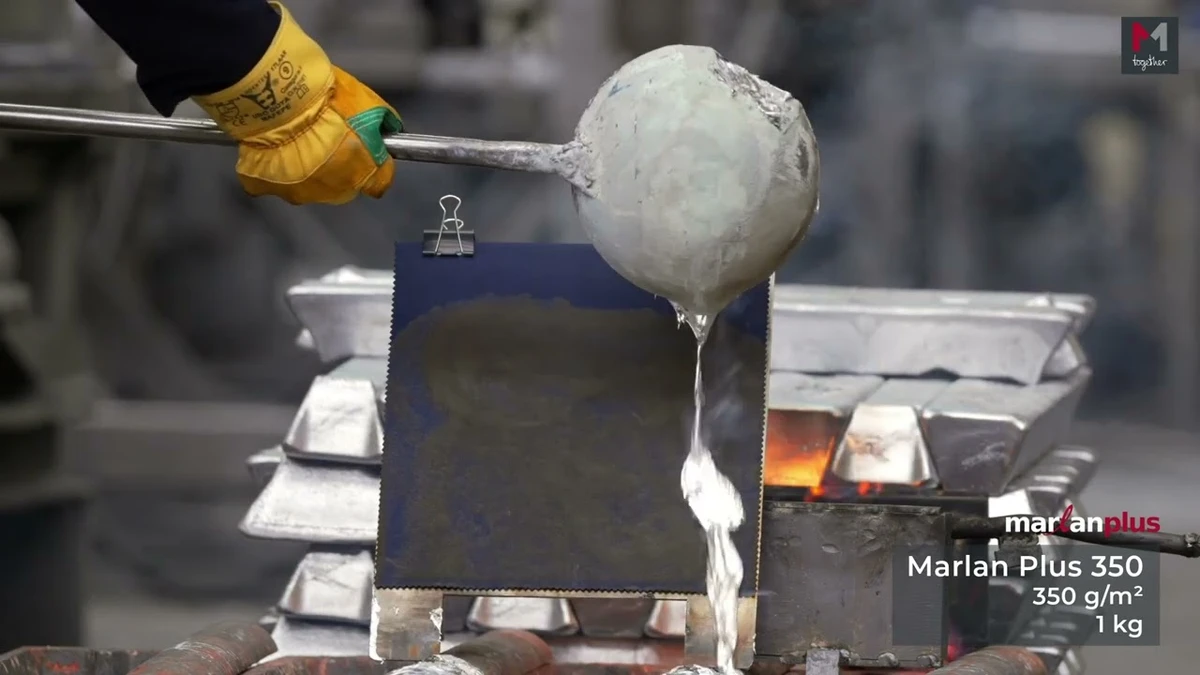
ISO 9185 Test Protocol & Thermal Response Phases
780°C Crucible & 45° Test Frame
Pure aluminum heated to ~780°C in a laboratory crucible is poured onto the Marlan Plus 350 specimen tensioned over a PVC skin-simulant film.
Molten Impact & Leidenfrost Repulsion
The incandescent stream strikes the fabric; the MARLAN PLUS outer matrix prevents alumina oxide wetting and adhesion.
Sub-Second Bead-Off Runoff
Unable to anchor to the non-stick surface, liquid aluminum rolls off in <1 second under gravity, cutting conductive heat transfer.
Zero Adhesion & Intact PVC Sensor
Post-pour inspection confirms zero burn-through, zero metal sticking, and zero blistering on the rear PVC simulated-skin film — Class D3 verified.
EN ISO 9185:2007 & EN ISO 11612 Performance Codes
Technical breakdown of the test methods, classification thresholds, and verified ratings required in foundry PPE specifications:
350 g/m² Korgan vs. ~615 g/m² Molten Extreme vs. ~900+ g/m² Heavy Systems
Every fiber in Marlan Plus 350 performs a dedicated engineering role: 60% Lenzing FR Viscose (non-melting flame backbone), 20% Pure Wool (Leidenfrost micro-vapor cushion & thermal insulation), 10% Polyamide (warp ≥ 30 N / weft ≥ 15 N tear & abrasion skeleton), and 10% TENCEL™ Lyocell (hygroscopic vapor absorption). At 350 g/m², Korgan is -61% lighter than ~900+ g/m² heavy leather/aluminized gear, cutting cardiovascular strain and heat stress.
1,050 g (5.25× D2 / 3× D3) Marina Textil Extreme Aluminum Pour Test
While EN ISO 9185 Class D3 requires ≥ 350 g of molten aluminum (accredited certification: 357–360 g Al, 208–212 g Fe, > 100 g Cryolite), Marina Textil subjected Marlan Plus 350 to a single 1,050 g (~780°C) molten aluminum pour (5.25× the D2 floor and 3× the D3 threshold). Result: < 1 s contact time, zero metal adhesion, and zero blistering or damage on the rear PVC simulated-skin sensor film.
Our Molten Metal Protection Solutions
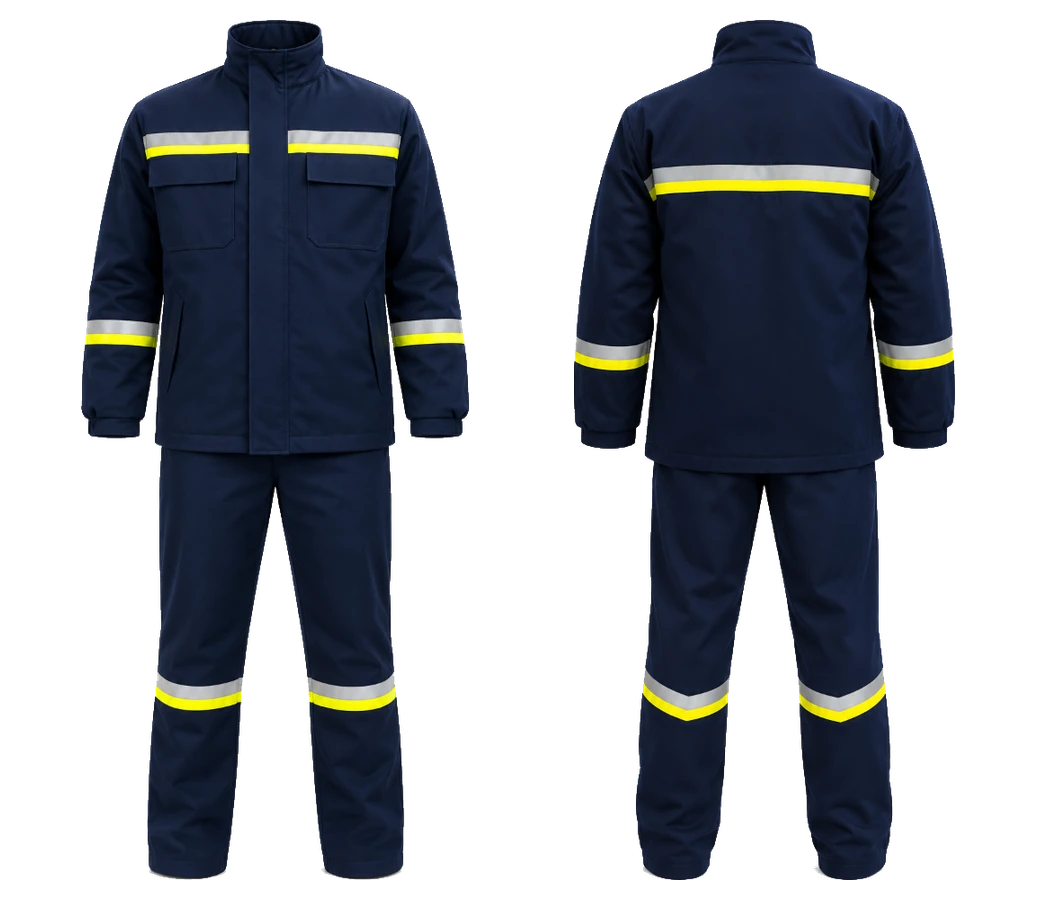
Two specialized protective systems engineered around the ergonomic mobility and radiant heat demands of your facility:

How to Select the Right Ensemble by Operational Zone?
Across metal foundries, steelmaking melt shops, and high-temperature pyro-process plants (calciners, preheater cyclones, rotary kilns), thermal hazards divide into two primary duty groups:
Korgan Suit + Interlocking Velcro FR Hood (350 g/m²)
Ideal for foundry molding/coremaking, overhead cranes, maintenance lines; in pyro-process plants, engineered for preheater cyclone and calciner air-lance blockage clearing (900–1100°C hot dust and raw-meal blowback) and clinker cooler / conveyor lines (ISO 12127 F1 contact heat). Its -61% lighter 350 g/m² single-layer architecture prevents heat stress, while the Velcro FR hood interlocks with the jacket collar for 360° neck-nape-shoulder dust and splash sealing.
Molten Extreme 3-Layer Coat (~615 g/m²) + Korgan Ensemble
Mandatory for furnace tapping, ladle pouring, slag skimming, and ~1450°C rotary kiln sintering / burner-pipe inspection ports under intense infrared (IR) radiation. Delivers breathable ISO 6942 Class C2 (RHTI24 = 37.4 s) felt-barrier defense (not aluminized, not C3 and not C4). Worn as an integrated system with Korgan Interlocking FR Hood, Korgan Trousers, safety helmet, and 95% IR-reflective gold-coated visor.
Launder in field operations at max 40°C (no softeners or chlorine bleach) to preserve the MARLAN PLUS 20% pure wool keratin matrix. Backed by a 5-year shelf life and 3,000 sets/month domestic manufacturing capacity; tender deliveries include 1 witness sample suit + 50 × 100 cm test fabric swatch.
Produced under Universal (2163) Module D QA with a 1-year manufacturing warranty. BundleTec engineers perform a 5-step on-site PPE audit at Months 4, 8, and 12 (physical integrity, thermal trace, seam/reflective check, wash compliance, written EHS report).
4-Fabric Technology Comparison & Total Cost of Ownership (TCO) Matrix
| Performance & TCO Criterion | Chemically Treated FR Cotton (Proban etc.) | Aramid / Modacrylic Blends | Aluminized / Heavy Leather (~900+ g/m²) | Marlan Plus 350 (Korgan & Molten Extreme) |
|---|---|---|---|---|
| Molten Al & Fe Splash Behavior | Borderline D1/D2; burn-through risk as chemical finish washes out | Fails — molten aluminum adheres to fiber surface and conducts heat to skin | Reflects while foil is intact; metal-trapping hazard inside crease cracks | D3 (357–360 g Al; 1,050 g extreme proof) + E3 (208–212 g Fe) + <1 s runoff |
| Radiant Heat & Shift Ergonomics | C1; stiffens with washing and loses breathability | C1; low moisture regain creates steam scald risk in sweaty garments | High IR reflection but ~900+ g/m² mass, zero sweat vapor escape, severe heat stress | Korgan: 350 g/m² (-61% lighter, C1) | Molten Extreme: ~615 g/m² C2 (RHTI24 = 37.4 s) |
| FR Permanence & Wash Lifespan | Chemical treatment degrades with hard water and laundering (frequent replacement) | Inherent FR, yet unsuitable for foundry slag and aluminum splash outer shells | Cannot be industrially laundered; foil delaminates under mechanical abrasion | Fiber-Inherent FR — Fabric 75°C 50 Washes (EN ISO 15797) / Field Care 40°C |
| Annual TCO & Field Assurance | 3–4 suits consumed per worker/year drives high recurring budget cost | High unit cost + premature scrap due to molten metal adhesion | Frequent foil replacement + unsuitable for continuous full-shift wear | 60–70% lower annual consumption + 1-Yr Warranty + Month 4/8/12 Field Audits |
Official Technical Data Sheets (TDS) & Warranty Documents (PDF)
Technical Evaluation for Your Foundry or Plant
Share your molten metal or pyro-process type (Al, Fe, Cryolite, Kiln/Cyclone), operating temperatures, and headcount; let us specify the right garment configuration and test swatch together.