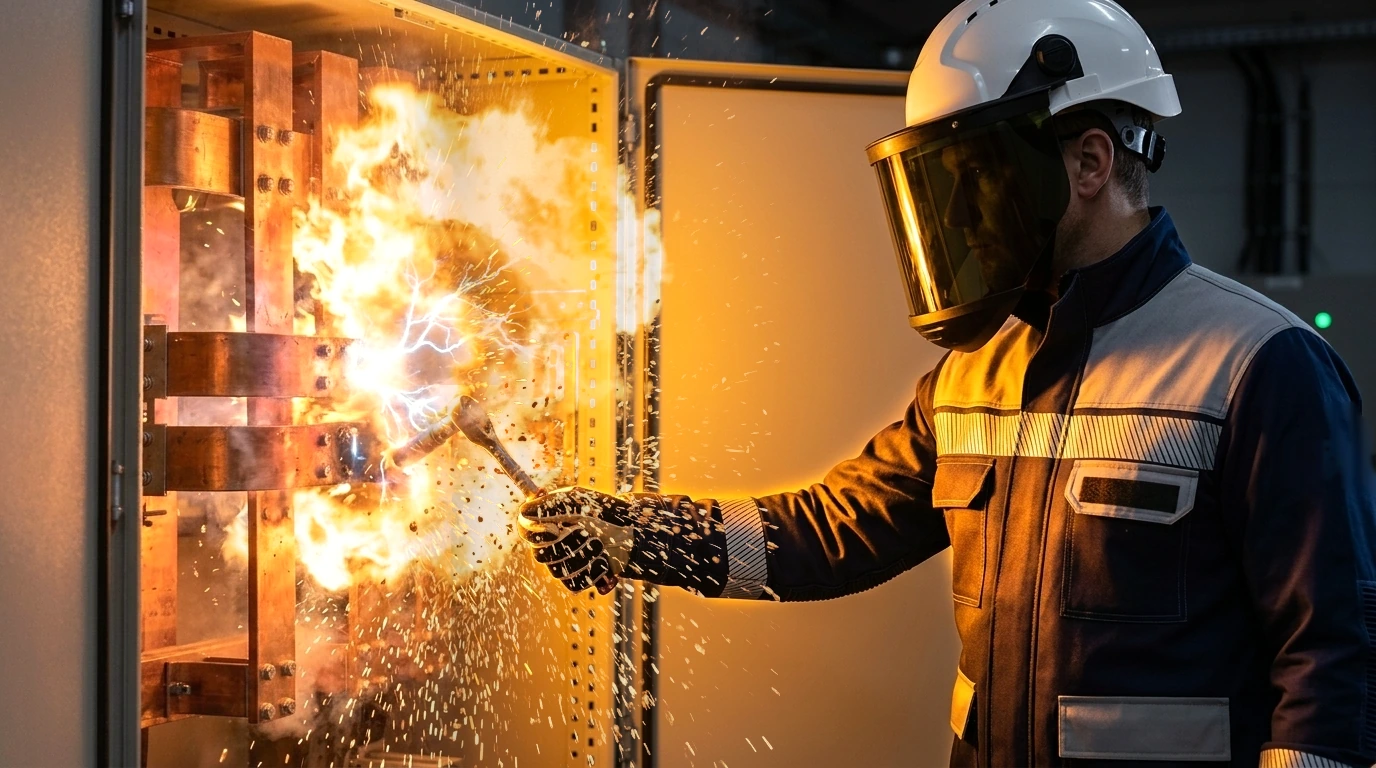
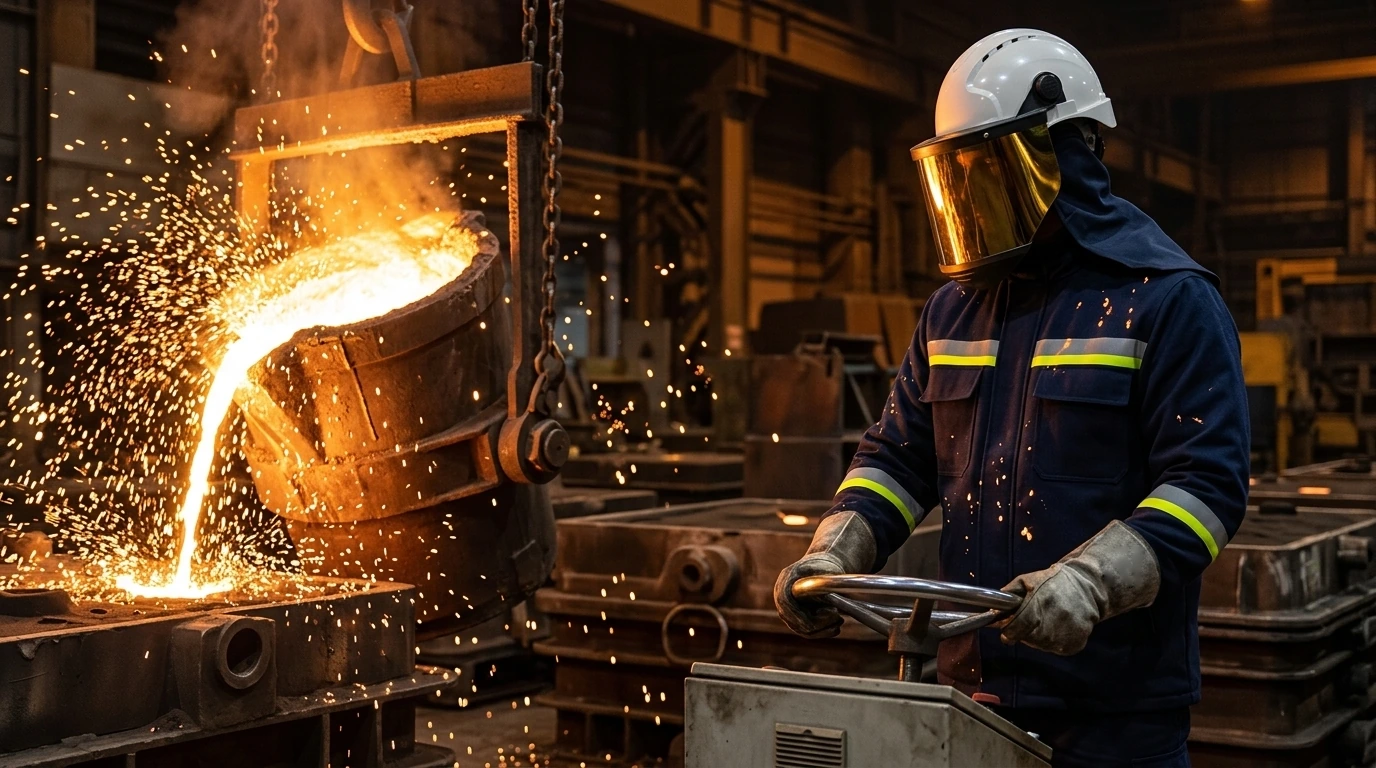
In industrial casting floors, blast furnaces, and steelmaking melt shops, risk is dynamic rather than static. In flagship heavy industry facilities like Erdemir and İsdemir, technicians performing ladle pouring, slag skimming, liquid metal transfer, and continuous casting operations confront incandescent molten streams at thousands of degrees Celsius within milliseconds.
While the conventional D2 performance level found in legacy tender specifications may appear sufficient on paper for "ideal and controlled" laboratory conditions, real-world accidents on the shop floor always push protection boundaries to the extreme. During a ladle leak or mold blowout, the mass of splashing molten metal vastly exceeds the 200-gram laboratory test ceiling. That is why the D3 and E3 performance class in foundry clothing is not a luxury specification—it is the sole safety standard capable of preventing fatal burns.

1. Critical Mass & Heat Transfer: The 200g D2 Trap vs. 1000g+ D3 Reality
In the international ISO 9185 (EN ISO 11612 Code D) molten aluminum splash test, performance is divided into three distinct classes:
- Level D1: 100 g to 200 g of molten aluminum splash.
- Level D2: 200 g to 350 g of molten aluminum splash (Typical test threshold: 200 grams).
- Level D3: ≥ 350 g of molten aluminum splash (Highest category in the standard).
Many foundry technical specifications still specify Level D2. However, during a ladle overflow or nozzle blockage, the mass of liquid metal ejected into the workspace is never limited to 200 grams. Two hundred grams is barely the volume of a small coffee cup of liquid metal!
A 200-gram molten splash is the absolute ceiling where testing stops for D2 fabrics. Every gram of molten metal above this threshold fails to slide off the D2 surface and infiltrates between the fibers—making direct contact with human skin underneath and causing deep tissue destruction (3rd- and 4th-degree burns carrying amputation risk).
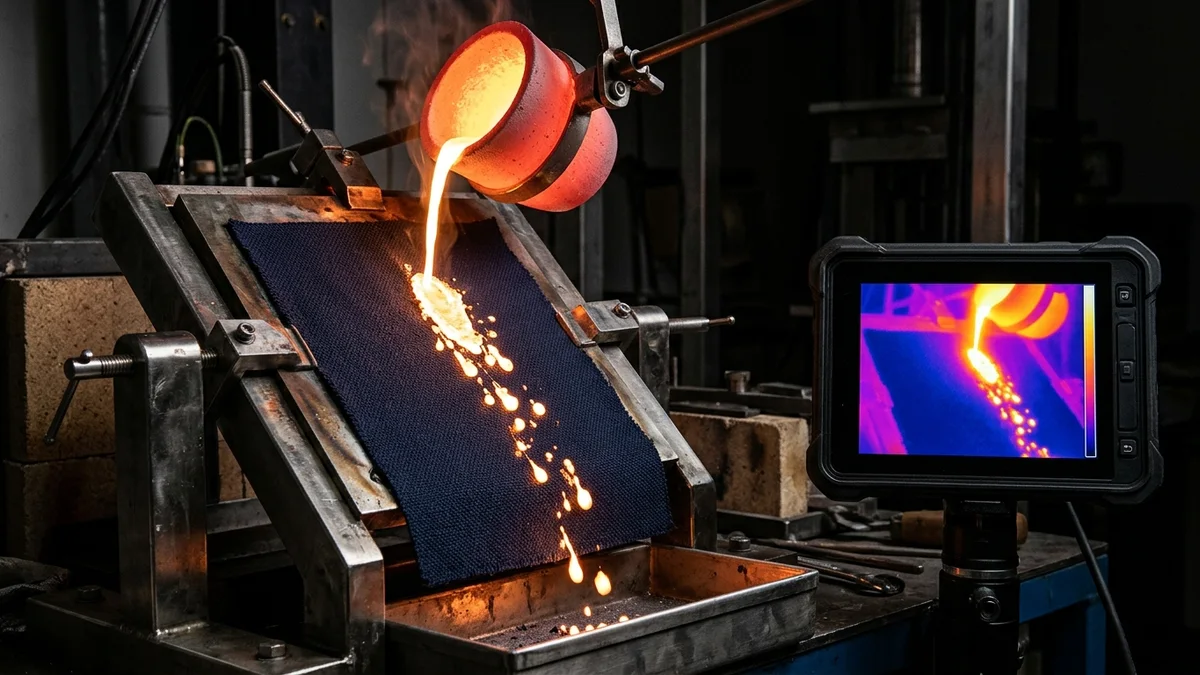
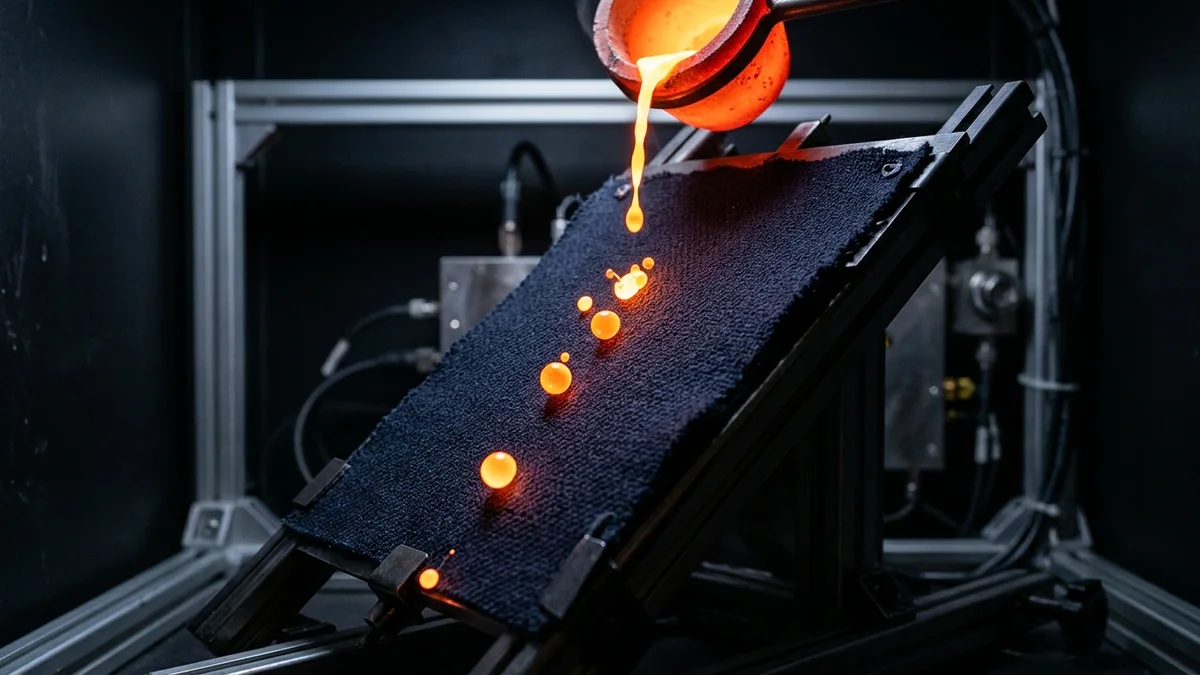
Conversely, Level D3 ensures not only that the fabric resists ignition, but also that molten metal cannot adhere to the textile fibers even at a microscopic level—rolling rapidly off the surface like a droplet of mercury (repellent / bead-off effect).
Pioneering Marlan Plus 350 and certified domestic Korgan fabric systems treat the 350-gram minimum threshold of the D3 standard (verified 357–360 g Al and 208–212 g Fe) not as a finish line, but as a starting point. In accredited laboratory extreme pour tests, they maintained complete thermal integrity against a massive 1050-gram (5.25× D2) incandescent molten metal pour, recording zero damage on the underlying PVC skin simulator.
Risky ceiling of legacy specifications; anything above 200g causes direct 3rd-degree burns.
Baseline acceptance value for the highest ISO 9185 class; non-stick surface standard.
Zero skin simulator damage against a 1.05 kg molten metal impact (5.25× D2 performance margin).
2. Dual-Metal Risk & Synergistic Protection: Aluminum Adhesion vs. Iron Radiation
Unlike single-metal foundries, integrated metallurgical giants like Erdemir and İsdemir operate across a multi-layered hazard map. While 1400°C–1550°C molten iron and steel flow through blast furnaces and basic oxygen converters, 700°C–780°C molten aluminum and zinc baths are operated in deoxidation, alloying, and continuous galvanizing lines.
These two molten metals trigger two diametrically opposed, lethal physical mechanisms upon impacting textile fibers:
| Metal Type | Temperature | Primary Physical Hazard | Fabric Behavior & Vulnerability | Required Protection Class |
|---|---|---|---|---|
| Molten Aluminum | 780°C ± 20°C | Wetting & Adhesion | Low viscosity; becomes trapped in the pores of fibers like aramid, adheres, and burns through from within. | ISO 9185 D3 (≥350g) |
| Molten Pig Iron / Steel | 1400°C ± 20°C | Extreme Radiant Heat & Mass | Emits intense thermal radiation; causes instantaneous charring and thermal shock of fabric fibers. | ISO 9185 E3 (≥200g) |
Many safety officers assume that because molten iron is nearly twice as hot as molten aluminum, iron protection automatically covers aluminum. This is a fatal materials science misconception!
Thermodynamically, molten aluminum carries a +32% higher specific heat capacity (cp = 1.08 J/g·K vs. 0.82 J/g·K for iron), a +61% higher latent heat of fusion (ΔHf = 397 J/g vs. 247 J/g), and nearly triple the liquid thermal conductivity (~94 W/m·K vs. ~35 W/m·K). Combined with its wetting affinity, splashing aluminum adheres tenaciously to D2 or aramid fabrics and dumps its entire latent heat directly into the skin. Furthermore, our breathable hygroscopic MARLAN PLUS fabric architecture wicks sweat away from the body so trapped moisture cannot flash-boil at 100°C into a secondary Steam Scald Burn.
Therefore, the golden rule of safety in integrated sites like Erdemir and İsdemir is D3 and E3 synergy. Both non-stick fiber technology that repels aluminum (D3) and a thermal shield capable of withstanding 1400°C incandescent iron (E3) must be unified in a single garment.
3. The Molten Cryolite Test: Ultimate Proof of Heavy Industry Expertise
One of the most critical parameters for performance that goes beyond standard industrial testing is Molten Cryolite resistance.
Cryolite (Sodium Hexafluoroaluminate - Na3AlF6) is a highly fluid and chemically aggressive molten salt used at 950°C–1000°C in aluminum smelting and electrolysis reduction cells. Molten cryolite is far more penetrating and destructive to the molecular bonds of textile fibers than any conventional molten metal.
Marlan Plus 350 technology has passed one of the world's most demanding metallurgical tests—the Molten Cryolite test—at over 100 grams with zero penetration and zero skin simulator damage. Success in this test proves the fabric's molecular durability and confirms the top-tier safety classification required by facilities like Erdemir and İsdemir.
No fabric that fails the cryolite test can provide comprehensive protection for personnel in primary smelting baths and slag operations. Adding the clause "ISO 9185 D3 / E3 and Molten Cryolite Test Report" to your fabric tender specification is the most effective corporate filter to prevent inferior workwear from entering the shop floor.
4. Safety Analysis by the Numbers: +500% Capacity & Vital Escape Seconds
The difference between D2 and D3 is not a minor alphabetical step. This transition provides the foundry technician with a 500% increase in protective capacity and the vital escape seconds needed to evacuate an accident unharmed.
Multi-Layer Protection Comparison
Legacy Specification (D2) vs. Marlan Plus 350 & Korgan (D3/E3) Radar Analysis
Molten Metal Resistance Capacity (Grams)
500% Capacity Increase from 200g Critical Limit to 1000g+ (1050g) Safe Zone
The 1000g+ (1050 grams) molten metal performance of Marlan Plus 350 and Korgan technology buys your personnel the vital seconds needed for escape, evacuation, and emergency response during unexpected accidents and ladle overflows.
200 grams of aluminum splash is the laboratory ceiling. The instant a ladle splash reaches 201 grams in the field, the fabric is breached or adheres to the skin. Escape margin and safety buffer are zero.
The highest class of the standard. Protects the underlying sensor membrane without damage against 350 grams of molten aluminum.
Nearly 3 times the D3 baseline and 5 times the D2 limit! In an unexpected ladle eruption, it provides the life-saving seconds a technician needs to step back to safety or pull the emergency quick-release flap to shed the garment.
5. Corporate OHS Leadership & Sustainable Investment (TCO Analysis)
In heavy industry, Occupational Health and Safety (OHS) is not an "expense item" on accounting ledgers—it is the guarantee of operational continuity, workforce loyalty, and international prestige.
Opting for cheap chemically treated fabrics (Proban / Pyrovatex coated cottons) in foundry garment procurement may look like short-term savings, but in Total Cost of Ownership (TCO) it turns into a heavy financial burden:
- Wash Degradation: Chemical finishes wash out of textile fibers after 10–15 industrial laundering cycles. The garment loses its flame retardancy and leaves workers defenseless in the field, forcing companies to purchase new suits 3–4 times a year.
- Liability and Downtime Risk: A single ladle splash accident involving D2 or chemically treated workwear leads to weeks of plant downtime, regulatory and judicial investigations, and multi-million-dollar compensation claims.
- Permanent Inherent Fiber Superiority: The MARLAN PLUS fiber architecture used in Marlan Plus 350 and Korgan is inherently flame-retardant. Under EN ISO 15797, even after 50 industrial washes, it loses none of its D3 and E3 protection. Its non-stick performance remains identical to day one throughout the garment's service life.
We do not merely supply fabric or garments. All our molten metal protective garments are delivered with a 1-Year Manufacturing Warranty and Tri-Annual (3×/Year, Every 4 Months) On-Site PPE Field Audits & OHS Reporting.
EN ISO 15797 (50 Washes) & Total Cost of Ownership (TCO)
While chemically treated topicals lose flame retardancy within 10–15 washes, the inherent MARLAN PLUS fiber architecture sustains uninterrupted 1000g+ D3/E3 non-stick shedding across 50 industrial wash cycles.
6. Korgan & Molten Extreme: Field-Proven D3/E3 Solutions
The most common mistake made when increasing protection levels in foundries is making the garment excessively thick (800–1000 g/m² leather or bulky aluminized armor), pushing operators to the brink of heat exhaustion and syncope. Thermal textile engineering is the art of delivering maximum protection at the lowest possible fabric weight.
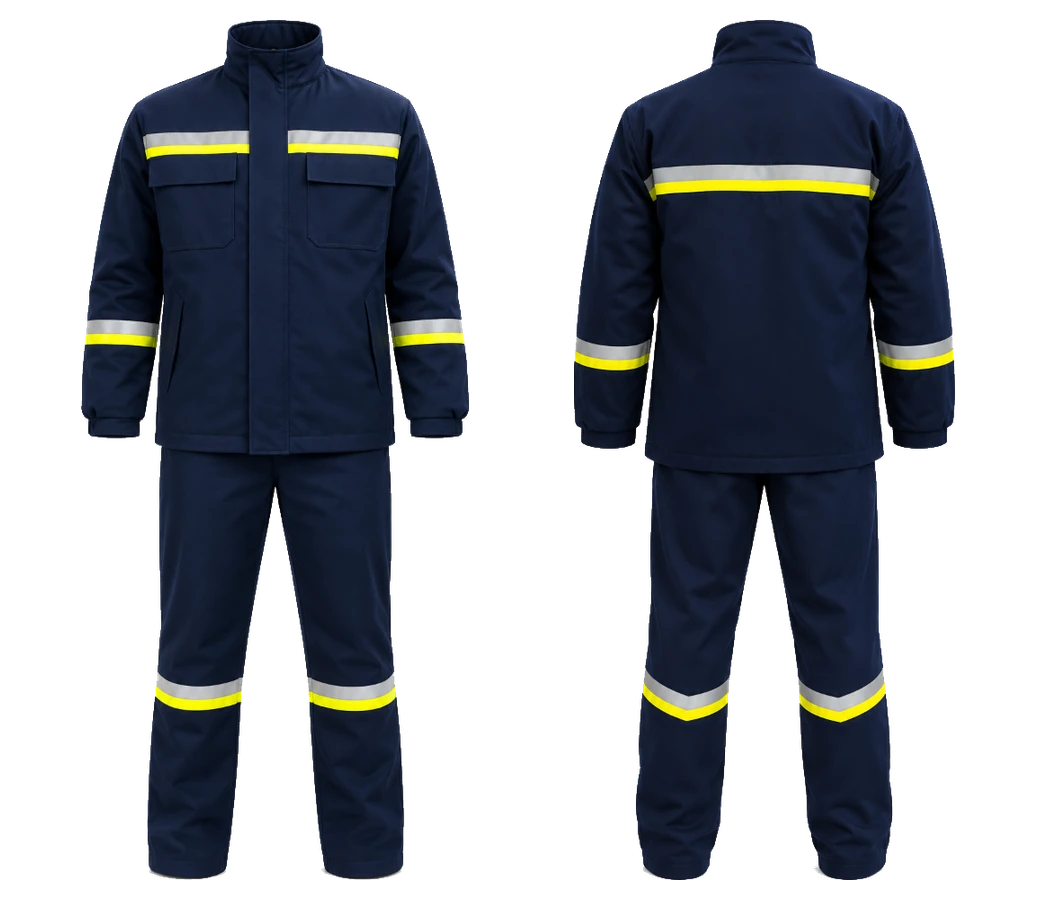
Korgan Molten Metal Protective Suit & Hood
Eliminates heat stress on the casting floor with its single-layer construction—combining jacket, trousers, and a standalone 350 g/m² protective hood interlocking via hook-and-loop to the stand-up jacket collar. Certified to both D3 and E3, secondary open-arc ATPV 9.0 cal/cm² rated, compliant with EN 1149-2 (1.78 × 10⁸ Ω) & EN 1149-5 antistatic and EN ISO 20471 FR strip / EN 17353:2020 Type B2 visibility.

Molten Extreme Multi-Layer Heavy Foundry Coat (~615 g/m²)
Non-aluminized reinforced 3-layer system (350 + 150 + 115 g/m²) certified by AITEX 0161 (Certificate 23/5783/00/0161) to EN ISO 11612 C2 radiant heat (RHTI₂₄ = 37.4 s). Features a Quick-Release emergency front storm flap, EN ISO 11612 Clause 4.2 Trap-Free pocketless exterior geometry, and EN ISO 20471 FR strip / EN 17353:2020 Type B2 visibility.
7. D3/E3 Tender & Procurement Specification Revision Guide
Below are sample tender specification clauses prepared for OHS leaders at Erdemir, İsdemir, and Turkey's metal casting industry. Updating your technical specification with these criteria prevents uncertified and inadequate garments from bidding:
2. The garment must be tested by an accredited laboratory in accordance with EN ISO 9185:2007 and achieve Code D3 (≥ 350g; verified 357–360 g) for Molten Aluminum and Code E3 (≥ 200g; verified 208–212 g) for Molten Iron without leaving any damage on the underlying PVC skin simulator.
3. The fabric manufacturer must submit an accredited Molten Cryolite Test Report (>100g resistance) within the tender dossier.
4. The garment shall satisfy EN 1149-2:1997 vertical electrical resistance ≥ 1.78 × 10⁸ Ω, EN 1149-5 antistatic design, and EN ISO 20471 FR strip / EN 17353:2020 Type B2 visibility criteria, certified for 50 industrial laundering cycles per EN ISO 15797.
5. The product shall carry a 1-year manufacturing warranty, and the supplier shall perform tri-annual (3×/year, every 4 months) on-site PPE field inspections and deliver a written OHS compliance/retirement report.
Frequently Asked Questions (FAQ)
Why does Level D2 foundry clothing fall short in real-world industrial accidents?
Why must both D3 and E3 ratings be required in integrated steel plants like Erdemir and İsdemir?
What is the Molten Cryolite test and why is it a critical indicator for foundry clothing?
How do Marlan Plus 350 and Korgan technologies withstand 1000 grams of molten metal?
How does D3/E3 certified clothing reduce Total Cost of Ownership (TCO) for an enterprise?
Request D3/E3 Fabric Samples & Specification Support for Erdemir, İsdemir, or Your Facility
Contact our engineering team to review Korgan and Marlan Plus 350 accredited test reports, 1000g+ molten metal and cryolite test video footage, and revise your corporate tender specifications.
Request D3/E3 Technical Consultation & Samples →