When selecting Personal Protective Equipment (PPE) against electric arc flash hazards in industrial facilities, the most confusing aspect of technical tender specifications is the variety of test methodologies and acronyms used across different regions and standards bodies.
While the IEC / EN 61482 series of standards is mandatory across Europe, multinational corporations and US-originated engineering projects frequently demand NFPA 70E, ASTM F1959, and IEEE 1584 compliance. So what exactly is ATPV? Why was ELIM introduced? And what does Box Test APC 2 signify?

1. Two Major Testing Philosophies: Open Arc vs. Box Test
Two fundamental laboratory test methods exist to simulate an electric arc flash explosion:
| Parameter | Open Arc Test — IEC 61482-1-1 / ASTM F1959 | Box Test — IEC 61482-1-2 |
|---|---|---|
| Test Geometry | Unconstrained 360° arc blast between two vertical electrodes in open air | Directed arc explosion confined inside an open-fronted paraboloid test box |
| Measured Output | Numerical incident energy: ATPV, EBT50, ELIM in cal/cm² (or kJ/m²) | Class-based rating: APC 1 (4 kA / 0.5 s) or APC 2 (7 kA / 0.5 s) |
| Sensor Array | Copper calorimeter sensors mounted on surrounding monitor panels (Stoll Curve) | 2 copper calorimeter sensors embedded in a torso mannequin plate |
| Global Acceptance | Accepted across both Europe (CENELEC) and North America (NFPA/ASTM) | Primarily required in European and German (DGUV) utility standards |
For maximum safety assurance, it is recommended that protective clothing hold accredited certifications from both Open Arc (cal/cm²) and Box Test (APC 2) methodologies simultaneously.
Model both arc regimes directly on your own facility topology: our in-house ArcSim engineering platform solves IEC 60909-0 short-circuit currents (Ik'', ip) across a dynamic SCADA Single-Line Diagram (SLD) to compute IEEE 1584-2018 open-arc incident energy (cal/cm², AFB) alongside DGUV 203-077 enclosed box-test arc energy (WLB, APC 1 / APC 2) in real time.
2. Battle of the Metrics: Comparing ATPV, EBT50, and ELIM
Three critical values appear on Open Arc laboratory test reports:
The incident energy level at which heat transmitted through the material carries a 50% statistical probability of causing a second-degree skin burn.
The energy level at which there is a 50% probability of the material physically splitting, tearing, or developing a hole—allowing arc flames to penetrate.
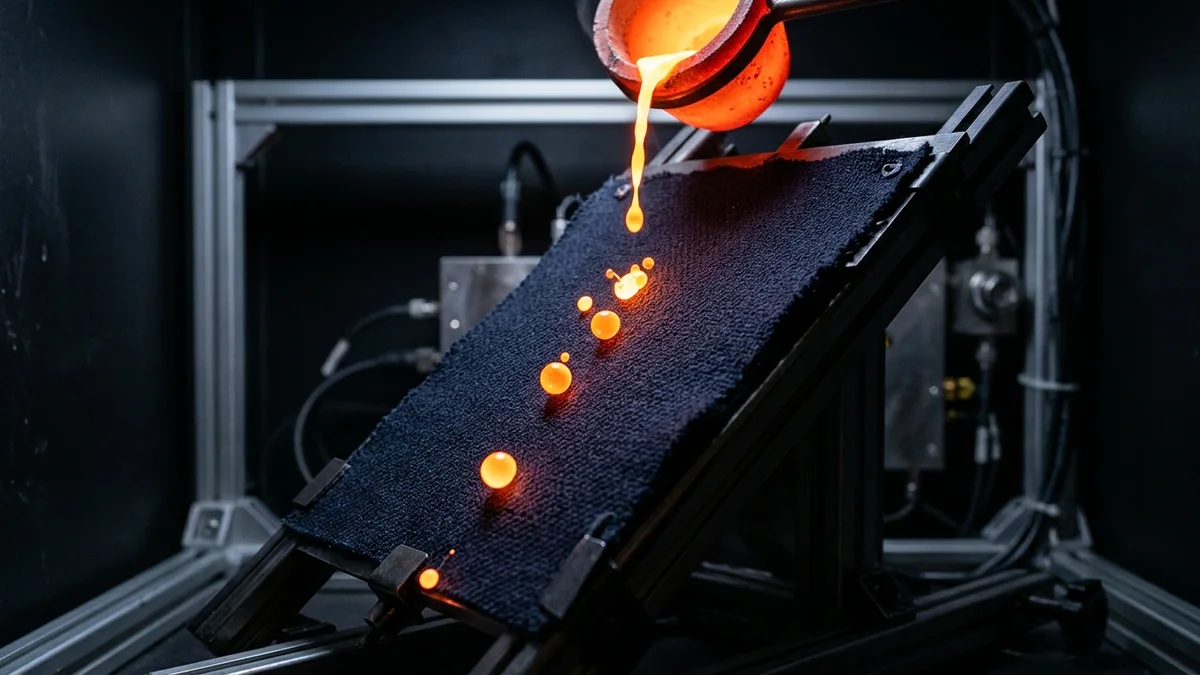
Introduced in the IEC 61482-1-1:2018 revision as the safest metric. Rather than 50%, it represents the 0% burn and 0% breakopen probability threshold!
When a garment rated strictly at 40 cal/cm² ATPV under legacy criteria is struck by a 40 cal blast, the wearer still faces a 50% statistical probability of a 2nd-degree burn. In a garment certified to ELIM = 40 cal/cm², the theoretical probability of a 2nd-degree burn at 40 cal is 0%!
3. The Box Test: APC 1 (4 kA) and APC 2 (7 kA) Classes
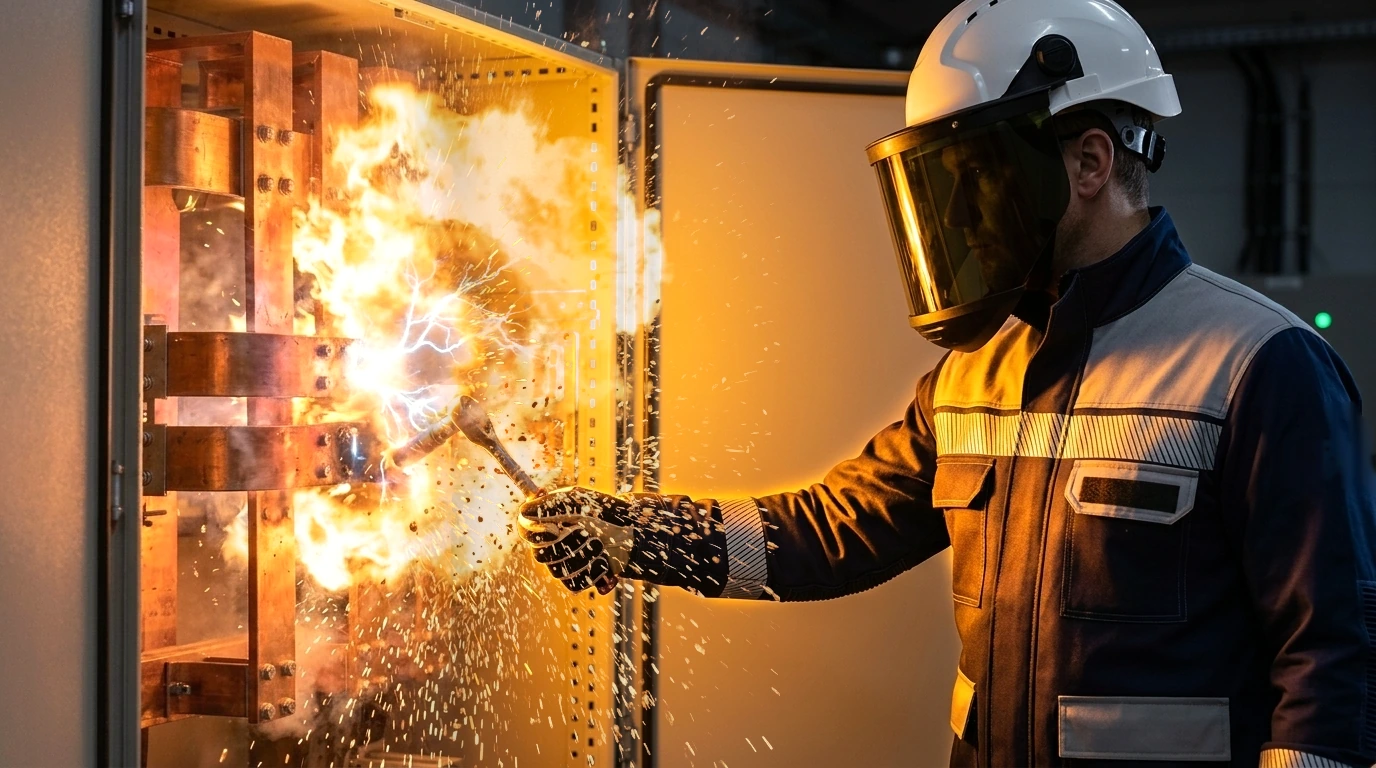
The EN 61482-1-2 box test detonates an electric arc inside a confined switchgear-like cavity for 0.5 seconds (500 ms):
- APC 1 (Arc Protection Class 1): 4 kA prospective short-circuit current (approx. 168 kJ arc energy). Intended for small low-voltage lighting sub-panels or auxiliary circuits.
- APC 2 (Arc Protection Class 2): 7 kA prospective short-circuit current (approx. 320 kJ arc energy). This is the mandatory minimum class for Main Distribution Boards (MDB), capacitor banks, and transformer substations.

4. NFPA 70E PPE Categories (Category 1 through 4)
The US National Fire Protection Association's NFPA 70E standard divides arc flash hazard levels in electrical installations into 4 primary PPE Categories:
| PPE Category | Minimum Required Arc Rating | Typical Operational Environment | Recommended PPE Combination |
|---|---|---|---|
| Category 1 | Minimum 4 cal/cm² | Operating small miniature circuit breakers (MCB) | Arc-rated shirt + trousers, safety glasses |
| Category 2 | Minimum 8 cal/cm² | Voltage testing on open standard 400V panels | 8 cal workwear, arc face shield, arc flash protective gloves |
| Category 3 | Minimum 25 cal/cm² | Molded case circuit breaker (MCCB) switching, Motor Control Centers (MCC) | 25 cal jacket + trousers, arc flash hood |
| Category 4 | Minimum 40 cal/cm² | Main distribution busbars, transformer cubicles, draw-out breakers | Arc Defender 40 Suit + ArSafe Gloves (125 cal) + 40 cal Hood |

NFPA 70E Category 4 (≥ 40 cal/cm²) Substation Switching
During draw-out circuit breaker (ACB/VCB) racking and main busbar maintenance, pairing the Arc Defender 40 suit (40 cal/cm² Garment ELIM & Garment ATPV / 49 cal/cm² Fabric ATPV) with 125.3 cal/cm² ArSafe gloves delivers full Category 4 compliance.
5. Lightweight Fabric Engineering: How Was 40 cal/cm² ELIM Achieved at 440 g/m²?
For decades, achieving Category 4 (40 cal/cm²) protection required stitching multiple heavy fabric layers and thick batting together, producing bulky 650 to 800 g/m² suits. Technicians working inside these heavy suits suffered severe heat stress within 15 minutes, experienced fogged visors from profuse sweating, and rushed tasks—leading to fatal errors.
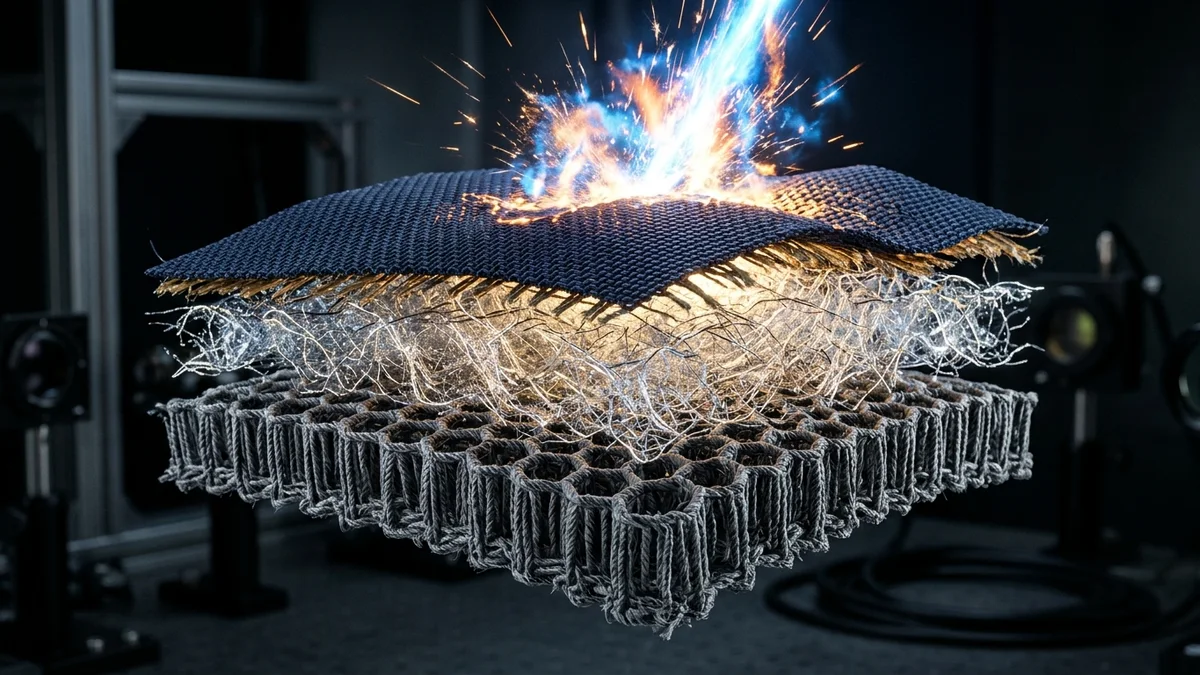
Arc Defender 40 solved this problem with a revolutionary 2-layer woven fabric geometry:

Arc Defender 40 Lightweight Arc Flash Suit
AITEX 0161 certified Model SMY2044 (EU Certificate 26/10153/00/0161/B). Tested with a 440 g/m² dual-layer micro-air-gap aramid system, delivering a lightweight jacket-and-trouser suit certified to 40 cal/cm² ELIM (49 cal/cm² Fabric ATPV) and APC 2 (7 kA).
Fabric Layer Architecture (AITEX 0161 Accredited Validation):
- Outer Layer (225 g/m² Ripstop Shell): 93% meta-aramid, 5% para-aramid, 2% antistatic fiber high-tenacity ripstop weave. Directly confronts arc plasma and forms an intumescent carbon barrier without igniting.
- Inner Thermal Barrier (215 g/m² Thermal Aramid Liner): 93% meta-aramid, 5% para-aramid, 2% antistatic inner liner. The micro-air gap trapped between the two layers dissipates convective and radiant heat flux below the Stoll Curve while completing EN ISO 11612 (A1+A2, B1, C1, F1) compliance.
- Total System Weight: Only 440 g/m² (35% lighter than conventional 40 cal systems).
6. Corporate Tender Specification Verification Checklist
Golden criteria that corporate procurement managers should include in tender specifications to avoid counterfeit or incomplete certificates:
- The Open Arc Test Report must be issued by an accredited European notified laboratory (e.g., AITEX 0161) and explicitly state an ELIM value of at least 40 cal/cm² (Fabric ATPV ≥ 49 cal/cm²).
- The garment must hold both a Module B EU Type-Examination Certificate (AITEX 0161) and a Module D Production Quality Assurance Certificate (Universal 2163) under EU PPE Regulation (EU) 2016/425 Category III.
- The garment must comply with EN 1149-5 electrostatic discharge and EN ISO 11612 heat and flame standards.
- For hand protection, arc flash gloves tested to both APC 2 and ASTM F2675 (such as ArSafe) must be mandated alongside the suit.
Frequently Asked Questions (FAQ)
What is the difference between ATPV and ELIM, and which is safer?
What is the difference between the Box Test and the Open Arc Test?
How does the Arc Defender 40 suit achieve 40 cal/cm² ELIM protection at only 440 g/m² weight?
Elevate Your Corporate Specifications to Accredited Standards
Request our AITEX accredited test reports, Module B / Module D certificates, and corporate tender specification templates from our engineers.
Request Technical Documentation & Samples →