On protective clothing engineered for industrial heat, flame, radiant flux, and molten splash, the EN ISO 11612:2015 pictogram communicates six distinct thermal hazards through letter codes A, B, C, D, E, and F.
Yet procurement tenders frequently confuse minimum Class 1 thresholds with peak Class 3 foundry endurance. This technical guide decodes every test method, exact pass criterion, Clause 4.2 garment anatomy rule, and operational selection matrix.
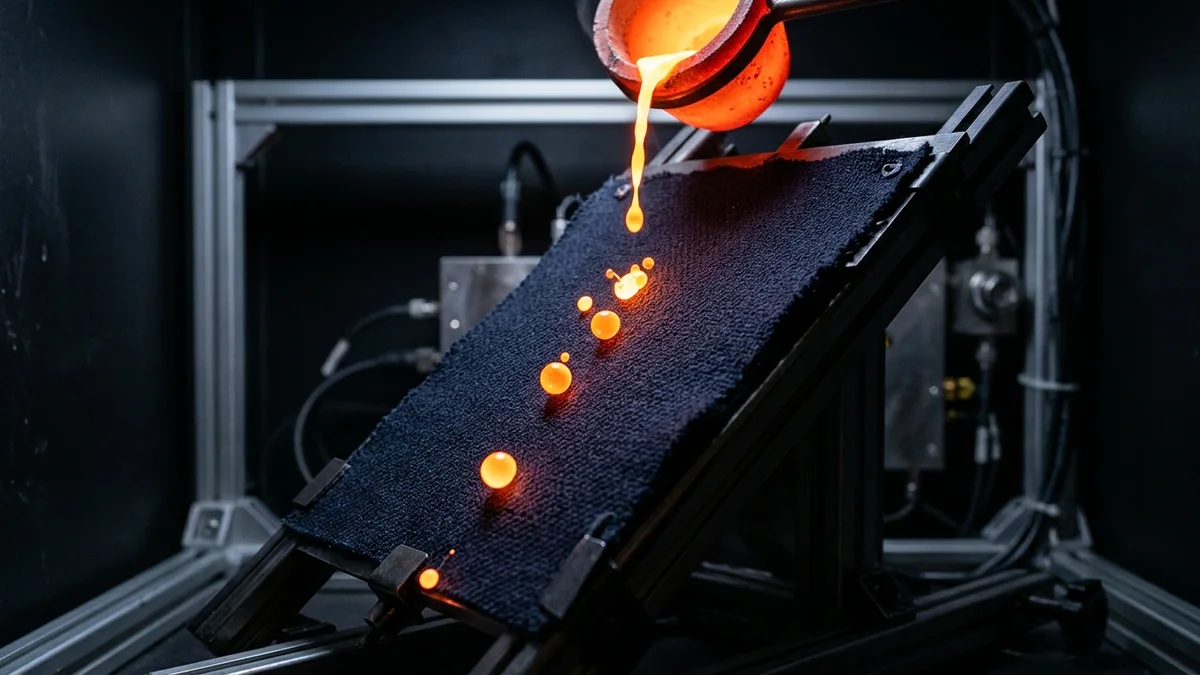
1. Scope of EN ISO 11612:2015 Under Regulation (EU) 2016/425
EN ISO 11612:2015 governs Category III industrial protective clothing exposed to brief contact with flame, convective heat, radiant heat, molten aluminum/iron splash, and contact heat (excluding firefighting and specialized welding, which carries EN ISO 11611).
Every compliant garment must pass Code A (A1 surface and/or A2 edge flame spread) alongside at least one code from B, C, D, E, or F, and must be re-tested after pre-treatment washing cycles (e.g., 50 industrial wash cycles per EN ISO 15797).
2. Complete A1, B1, C1–C4, D1–D3, E1–E3 & F1–F3 Codes Table
Each letter corresponds to a dedicated ISO calorimeter or molten-metal pour test, where higher numerical levels denote longer escape windows or heavier molten metal resistance:
| Code | Thermal Hazard & Test Method | Level 1 | Level 2 | Level 3 (and Level 4) |
|---|---|---|---|---|
| A1 / A2 | Limited Flame Spread (ISO 15025 Proc. A surface / B edge) | Afterflame/glow ≤ 2 s, no hole, melting, or flaming debris | — | — |
| B1 – B3 | Convective Heat — HTI24 (EN ISO 9151, 80 kW/m²) | B1: 4 – <10 s | B2: 10 – <20 s | B3: ≥ 20 s |
| C1 – C4 | Radiant Heat — RHTI24 (EN ISO 6942, 20 kW/m²) | C1: 7 – <20 s | C2: 20 – <50 s (Molten Extreme: 37.4 s) | C3: 50 – <95 s • C4: ≥ 95 s |
| D1 – D3 | Molten Aluminum Splash 780 °C (EN ISO 9185) | D1: 100 – <200 g | D2: 200 – <350 g | D3: ≥ 350 g (Korgan/Extreme: 1,050 g extreme pour) |
| E1 – E3 | Molten Iron Splash 1,400 °C (EN ISO 9185) | E1: 60 – <120 g | E2: 120 – <200 g | E3: ≥ 200 g (Korgan/Extreme: 208–212 g verified) |
| F1 – F3 | Contact Heat 250 °C — tt (EN ISO 12127-1) | F1: 5 – <10 s | F2: 10 – <15 s | F3: ≥ 15 s |
3. Field Distinction: Class C1 vs C2 & Non-Aluminized 3-Layer Engineering
In EN ISO 6942 radiant testing (20 kW/m² infrared flux), RHTI24 measures the seconds until a copper calorimeter behind the garment rises 24 °C. Single-layer 350 g/m² foundry suits (Korgan) achieve C1 with continuous-shift breathability, whereas furnace tapping and ladle transfer demand higher radiant attenuation.
Traditional aluminized foil coats trap 100 °C perspiration vapor inside (causing steam scald burns) and risk foil delamination. By contrast, the breathable, non-aluminized 3-layer Molten Extreme coat (~615 g/m²) combines a 350 g/m² non-stick MARLAN PLUS shell, ~150 g/m² meta-aramid thermal felt, and ~115 g/m² inner lining to deliver accredited RHTI24 = 37.4 s (Class C2) alongside D3 and E3 (AITEX CE 0161 Cert. 23/5783/00/0161).
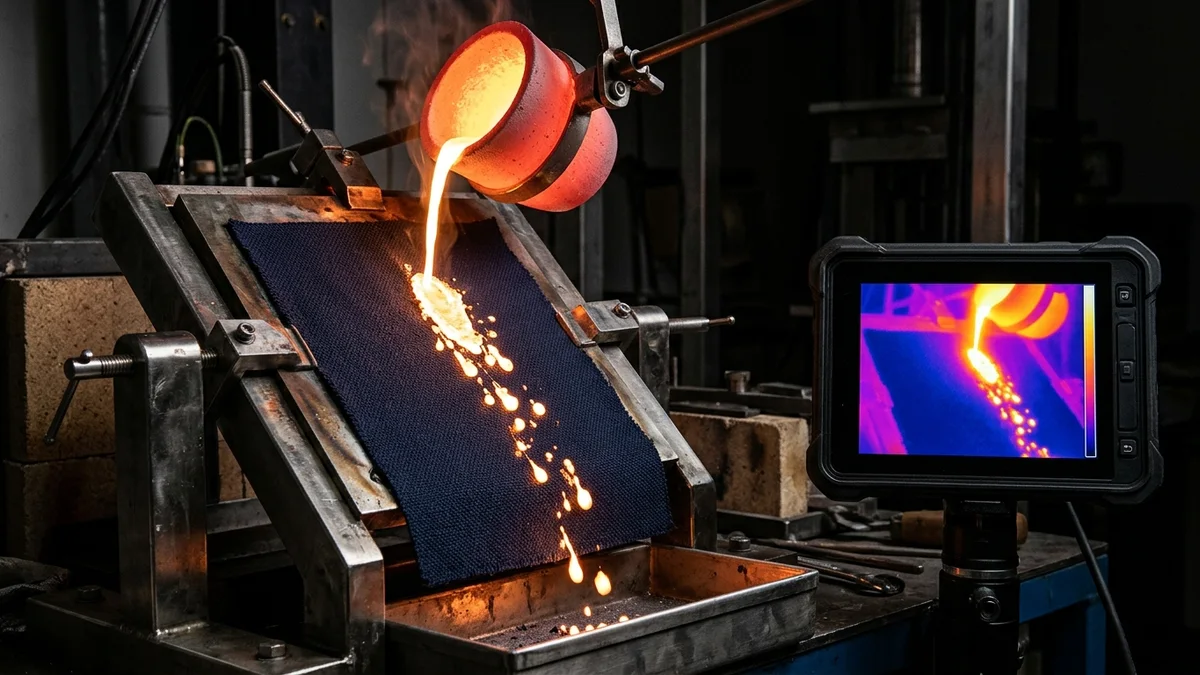
MARLAN PLUS Leidenfrost Micro-Vapor Cushion & D3/E3 Proof
Interstitial cellular moisture in MARLAN PLUS flashes into a protective Leidenfrost micro-vapor layer upon 780 °C aluminum or 1,400 °C iron impact, shedding liquid droplets with zero PVC skin-simulant damage.
4. Beyond Fabric: EN ISO 11612 Clause 4.2 Trap-Free Garment Anatomy
EN ISO 11612 certifies finished garment geometry as strictly as fabric physics. Garments carrying D or E molten-metal ratings must obey Clause 4.2 design rules:
- Trap-Free Exterior Geometry: Upward-facing open pockets, pleats, or trouser turn-ups that could catch molten metal droplets are strictly prohibited.
- Concealed Hardware: Zippers, snaps, and fasteners must be shielded behind flame-resistant storm flaps so conductive metal never contacts skin or splash.
- Jacket–Trouser Overlap & Stand-Up Collar: Minimum 20 cm overlap during bending/reaching plus a closed thermal collar to prevent neck entry.
- Emergency Quick-Release Doffing: High-radiant furnace intervention coats incorporate rapid one-pull front release closures for emergency egress.
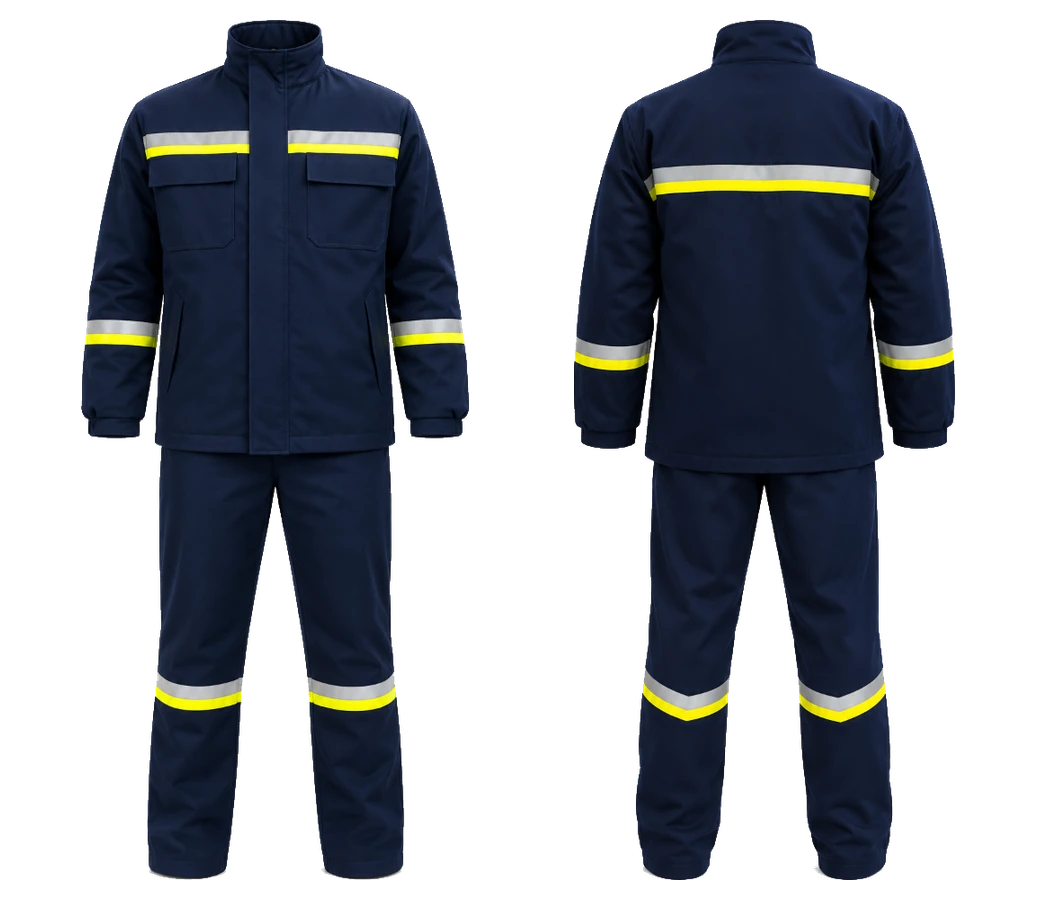
Korgan 350 g/m² MARLAN PLUS Foundry Suit & Hood
Certified to EN ISO 11612 (A1+A2 B1 C1 D3 E3 F1), EN ISO 11611 Class 2, EN 1149-5, EN 17353 Type B2, and 50 EN ISO 15797 washes with 61% weight reduction vs. legacy suits.
5. Operational EN ISO 11612 Code Selection Matrix
Match your plant's hazard audit directly to the certified EN ISO 11612 code profile below:
| Industrial Operation Zone | Required EN ISO 11612 Profile | Complementary Standards | Accredited Solution |
|---|---|---|---|
| MV/LV Electrical Switchgear & Substations | A1+A2 B1 C1 F1 | IEC 61482-2 (ELIM 40, APC 2), EN 1149-5 | Arc Defender 40 (SMY2044) |
| Continuous Aluminum & Iron Foundry Shift | A1+A2 B1 C1 D3 E3 F1 | EN ISO 9185, EN ISO 11611 Cl. 2, EN 17353 B2 | Korgan 350 g/m² MARLAN PLUS |
| Furnace Tapping, Ladles & High Radiant Heat | A1+A2 B1 C2 D3 E3 F1 | EN ISO 6942 (RHTI24 = 37.4 s), EN 17353 B2 | Molten Extreme (~615 g/m²) |
Class D2 stops at 200 g aluminum whereas Class D3 starts at 350 g (with MARLAN PLUS verified up to 1,050 g in extreme pour tests). Always mandate dual D3 + E3 ratings for metallurgical operations.
Frequently Asked Questions (FAQ)
What is the difference between A1 and A2 on an EN ISO 11612 label?
Why should foundry tenders require both D3 and E3 ratings together?
How does Molten Extreme achieve Class C2 radiant protection without aluminized foil?
Request Accredited Certificates & Custom Tender Specifications
Contact our engineering desk directly for AITEX CE 0161 Module B type-examination reports, Universal CE 2163 Module D QA documentation, and project-ready B2B technical quotations.
