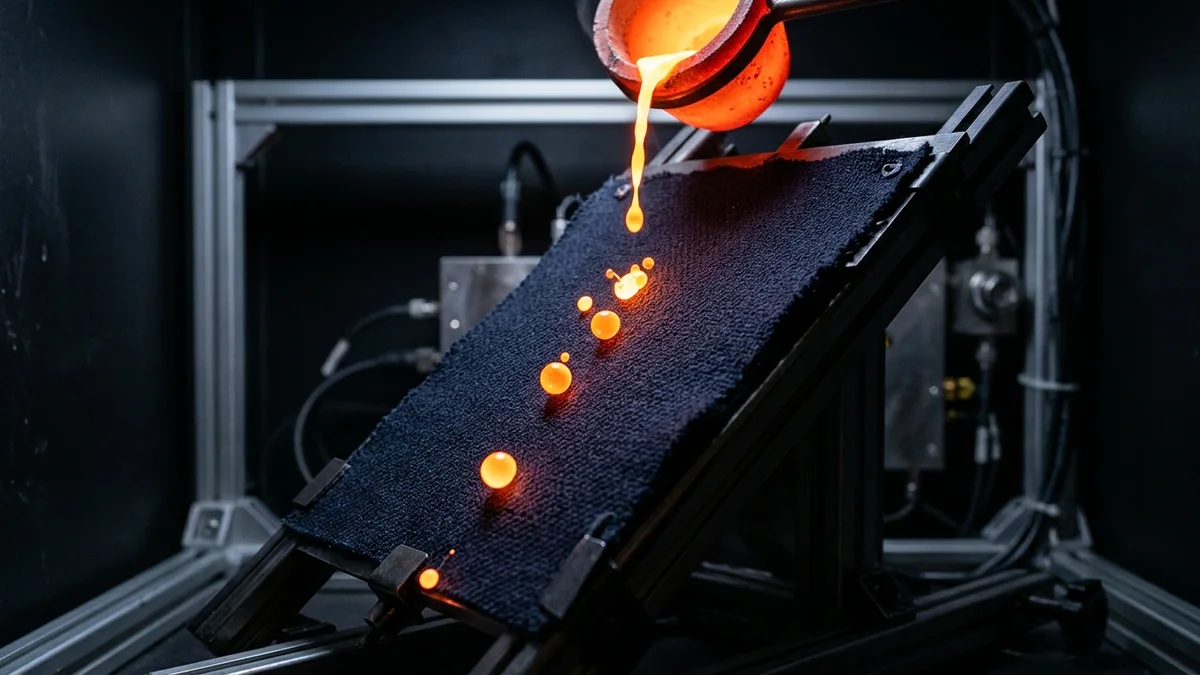
Across primary aluminum casthouses (720–780 °C), cryolite electrolysis cells, and integrated iron-steel foundries (1,400–1,600 °C), selecting protective clothing is a strict legal mandate under Regulation (EU) 2016/425 and national occupational safety frameworks.
Improper fiber selection—such as standard aramid or treated FR cotton—causes molten aluminum adhesion or traps sweat beneath impermeable coatings, triggering severe steam scald burns. This guide defines the accredited zone matrix and copy-ready tender clauses for metallurgical sites.

1. Legal Framework: Regulation (EU) 2016/425 Category III
Under Regulation (EU) 2016/425, garments protecting against environments exceeding 100 °C and molten metal splashes are classified as Category III PPE (protection against fatal or irreversible hazards).
Every legally compliant foundry garment must carry three verifiable elements in its label and EU Declaration of Conformity:
- Module B (EU Type-Examination Certificate): Issued by an accredited Notified Body such as AITEX CE 0161 verifying EN ISO 11612 and EN ISO 9185 ratings (e.g., AITEX 23/5783/00/0161 for Molten Extreme).
- Module D or C2 (Annual Quality Assurance): Ongoing production surveillance by Universal CE 2163 or equivalent Notified Body, marked alongside the CE symbol via its 4-digit code (e.g.,
CE 0161/CE 2163). - Whole-Garment Certification: Complete construction compliance including covered closures, angled flap pockets, and splash-shedding trouser cuffs—not merely loose fabric swatches.
2. Thermodynamics of Molten Aluminum (780 °C) vs. Iron-Steel (1,400 °C)
A frequent engineering misconception is assuming aluminum is milder than steel because of its lower melting point. In reality, liquid aluminum holds significantly higher specific heat capacity (1.08 kJ/kg·K), latent heat of fusion (397 kJ/kg), and thermal conductivity (~94 W/m·K)—meaning any droplet that sticks transfers devastating heat into skin within milliseconds.
| Thermophysical Parameter | Molten Aluminum (Al) | Molten Iron / Steel (Fe) | Impact on PPE Fabric Engineering |
|---|---|---|---|
| Typical Pouring Temp. | 720 – 780 °C | 1,400 – 1,600 °C | Iron drives high radiant flux (C2); aluminum drives wetting/adhesion |
| Specific Heat (cp) | 1.08 kJ/kg·K | 0.82 kJ/kg·K | Aluminum carries 32% more sensible heat per unit mass |
| Latent Heat (ΔHf) | 397 kJ/kg | 247 kJ/kg | Solidifying aluminum releases 61% more latent energy onto fabric |
| Thermal Conductivity (λ) | ~94 W/m·K | ~35 W/m·K | Adhered aluminum dumps thermal energy into skin rapidly |
| Required ISO 11612 / 9185 | Code D3 (≥ 350 g Al) | Code E3 (≥ 200 g Fe) | Multi-metal plants require dual D3 + E3 certification |
| Bath / Slag Hazard | Cryolite (~960 °C) | Furnace slag & sparks | MARLAN PLUS verifies 1,050 g extreme Al, 208–212 g Fe (E3) & >100 g cryolite |
Standard aramids allow molten aluminum to wet and cling to the weave. The MARLAN PLUS fiber architecture generates a controlled microscopic vapor cushion (Leidenfrost bead-off effect) that sheds splashes off the 45° plane cleanly, while high moisture vapor permeability eliminates the trapped perspiration and steam scald risk associated with sealed aluminized suits.
3. Zone-Based PPE Selection Matrix: Group A (Korgan) vs. Group B (Molten Extreme)
Issuing heavy aluminized proximity gear to every foundry worker accelerates heat stress and fatigue. Best-practice engineering separates Group A (Full-Shift Active Casting) from Group B (High-Radiant Furnace Front & Heavy Splash):
| Selection Criterion | Group A: Daily Casting & Ladle Shifts (Korgan) | Group B: Furnace Mouth, Oxygen Lance & Heavy Splash (Molten Extreme) |
|---|---|---|
| PPE System | Korgan Suit & Hood (MARLAN PLUS) | Molten Extreme Coat (Non-Aluminized) |
| Fabric Weight | 350 g/m² (61% lighter than 900 g/m² aluminized gear) | ~615 g/m² heavy-duty multilayer textile |
| EN ISO 11612 Codes | A1 A2 B1 C1 D3 E3 F1 | A1 A2 B1 C2 D3 E3 F1 |
| Radiant Heat (EN ISO 6942) | Class C1 (RHTI24 ≥ 7 s) | Class C2 (RHTI24 = 37.4 s) — non-aluminized, does not claim C3/C4 |
| EN ISO 9185 Splash | D3 (≥350 g Al; 1,050 g extreme Al), E3 (208–212 g Fe), >100 g cryolite | Full D3 (≥350 g Al) & E3 (≥200 g Fe) protection |
| Durability / Cert. | Verified after 50 industrial washes | AITEX CE 0161 Module B No. 23/5783/00/0161 |
| Target Operations | 8-hour casting line, ladle transfer, mold pouring, aluminum casthouse | Blast/EAF tapping, slag skimming, sustained radiant heat flux |
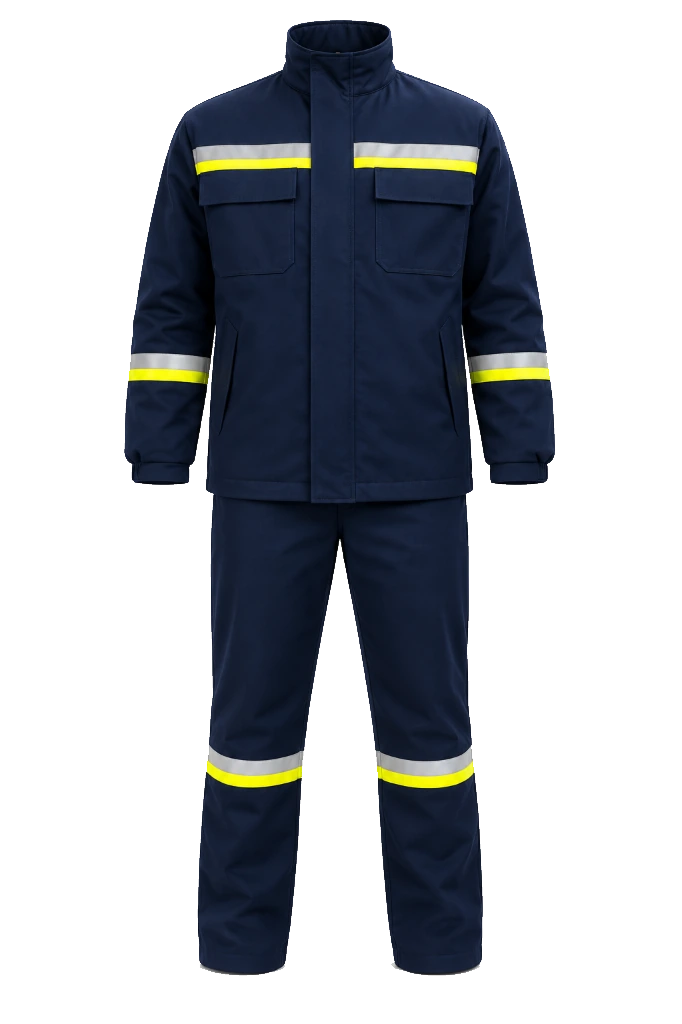
Korgan D3/E3 Foundry Suit & Protective Hood
61% lighter than 900 g/m² aluminized suits: breathable 350 g/m² MARLAN PLUS weave verified for D3 (1,050 g extreme aluminum pour), E3 (208–212 g molten iron), >100 g cryolite, and 50 industrial wash cycles.
4. Why Non-Aluminized Molten Extreme (Class C2 — 37.4 s)?
Conventional aluminized foil coats lose reflectivity rapidly in daily metallurgy due to crease delamination, slag dulling, and foil peeling, while their vapor-impermeable membrane drives internal heat stress.
The Molten Extreme Coat uses a non-aluminized (~615 g/m²) heavy-duty textile architecture with zero foil-peeling risk, verified by AITEX CE 0161 (23/5783/00/0161) to EN ISO 11612 Class C2 (RHTI24 = 37.4 s), D3, and E3.
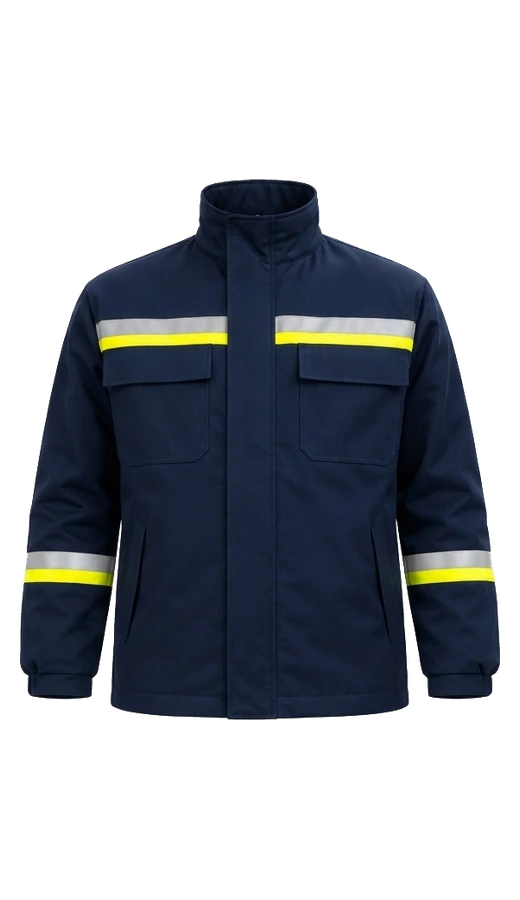
Molten Extreme Heavy-Duty Foundry Coat
Non-aluminized ~615 g/m² design delivering Class C2 (RHTI24 = 37.4 s) radiant barrier and D3/E3 molten splash protection with zero foil delamination.
5. Six Mandatory Clauses for Foundry PPE Tender Specifications
Copy these six engineering clauses directly into your aluminum or steel foundry procurement tender:
- EU 2016/425 Category III Documentation: Bids must attach an accredited Notified Body (e.g., AITEX CE 0161) Module B certificate and active Module D/C2 QA approval.
- Simultaneous D3 + E3 Splash Rating: Garments must hold EN ISO 11612 + EN ISO 9185 certification for both D3 (≥350 g Al) and E3 (≥200 g Fe); D1/D2 or E1/E2 substitutes are rejected.
- Non-Stick Fiber & Cryolite Verification: Shift suits (Korgan class) must utilize MARLAN PLUS or accredited non-stick equivalent verified to D3 (≥350 g; 1,050 g extreme aluminum pour), E3 (≥200 g; 208–212 g molten iron), and >100 g cryolite for aluminum cells.
- High-Radiant Furnace Coat: Heavy-splash coats (Molten Extreme class) shall provide non-aluminized construction rated to EN ISO 11612 Class C2 (RHTI24 ≥ 37 s, verified 37.4 s), D3, and E3 without foil-peeling failure modes.
- Zero Splash-Trap Garment Geometry: Jackets and trousers must omit turn-up cuffs and open pockets; all metal fasteners must be fully concealed behind storm plackets.
- 50-Wash Retention & Boot Overlap: Protection must remain certified after 50 industrial washes, and trouser legs must overlap EN ISO 20349-2 foundry boots cleanly.
Frequently Asked Questions (FAQ)
Why is standard aramid fabric not recommended for molten aluminum foundries?
Is the Molten Extreme coat aluminized, or rated to Class C3/C4?
23/5783/00/0161), it achieves EN ISO 11612 Class C2 (RHTI24 = 37.4 s), D3, and E3 without foil delamination risk.
Does Korgan retain D3/E3 protection after 50 industrial wash cycles?
Request Accredited Certificates & Custom Tender Specifications
Contact our engineering desk directly for AITEX CE 0161 Module B type-examination reports, Universal CE 2163 Module D QA documentation, and project-ready B2B technical quotations.