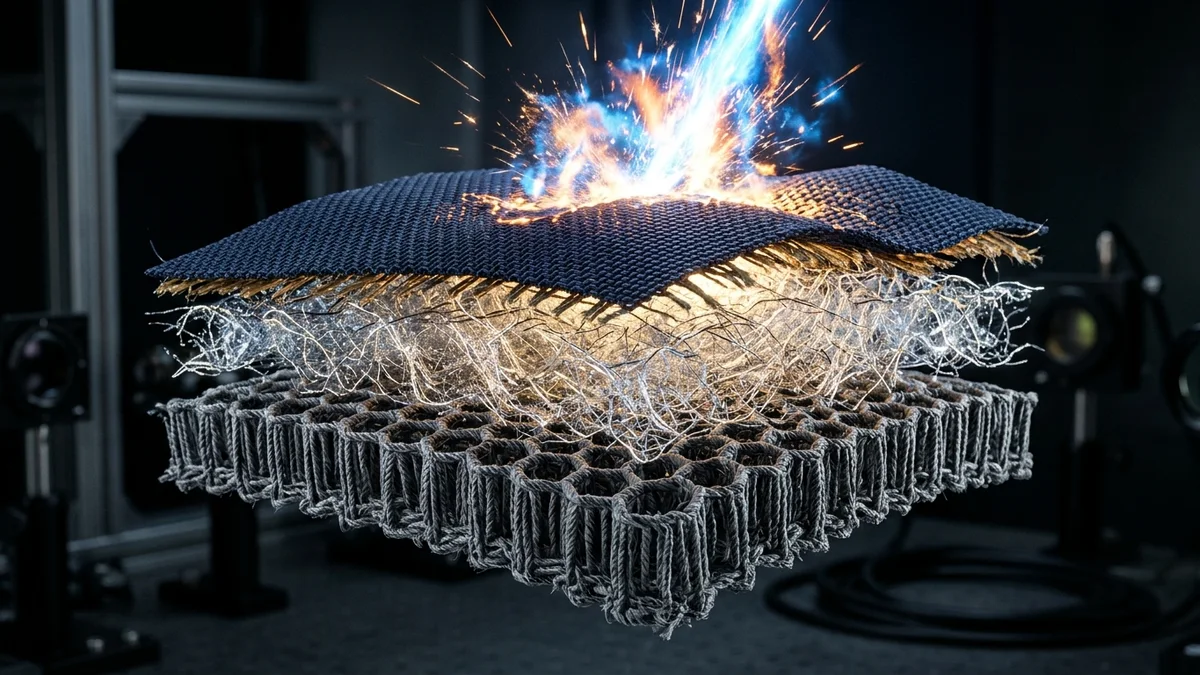
Introduced in the 2018 revision of IEC 61482-2 to replace legacy "Class 1 / Class 2" labels, APC 1 (4 kA) and APC 2 (7 kA) classify how effectively protective clothing withstands a directed switchgear cubicle arc flash.
While 4 kA vs. 7 kA looks like a modest current step on paper, enclosure focusing multiplies thermal flux more than threefold. Below we break down the EN 61482-1-2 test geometry, DGUV 203-077 energy calculations, and switchgear selection rules.

1. How the EN 61482-1-2 Enclosed Box Test Works
Unlike IEC 61482-1-1 Open-Arc testing where plasma expands radially in open air, the EN 61482-1-2 Box Test replicates a confined electrical cubicle. Two electrodes (aluminum upper, copper lower, 30 mm gap) are mounted inside a plaster box open on the front face.
A 400 V AC (50 Hz) fault arc burns for 500 ms (0.5 s), projecting directed plasma, thermal radiation, and molten metal vapor across a 300 mm distance directly onto fabric calorimeters (Material Box Test) and a dressed torso mannequin (Garment Box Test).
2. APC 1 (4 kA) vs APC 2 (7 kA) Technical Comparison Table
Compare the exact electrical, calorimetric, and garment construction thresholds between both protection classes:
| Test / Engineering Parameter | APC 1 (Legacy Class 1) | APC 2 (Legacy Class 2) |
|---|---|---|
| Prospective Short-Circuit Current (Ip) | 4 kA (400 V AC, 50 Hz) | 7 kA (400 V AC, 50 Hz) |
| Arc Duration (tarc) & Distance | 500 ms (0.5 s) • 300 mm | 500 ms (0.5 s) • 300 mm |
| Nominal Total Arc Energy (WLB) | ~168 kJ (158 ± 34 kJ) | ~320 kJ (318 ± 44 kJ) |
| Mean Directed Incident Energy | ~135 kJ/m² (~3.2 cal/cm²) | ~423 kJ/m² (~10.1 cal/cm²) |
| Typical Garment Architecture | Single-layer FR (250–350 g/m²) | Dual-layer aramid (e.g. 440 g/m² Arc Defender 40) |
| Pass Criteria (Stoll & Integrity) | Below Stoll, afterflame ≤ 5 s, hole ≤ 5 mm, no melt | Below Stoll, afterflame ≤ 5 s, hole ≤ 5 mm, closures operable |
| Typical Industrial Application | Sub-distribution lighting boards, low-fault circuits | Main distribution boards, MCCs, capacitor & MV/LV bays |
Moving from 4 kA (APC 1) to 7 kA (APC 2) raises current by 75%, yet box focusing drives incident energy at the specimen from ~135 kJ/m² to ~423 kJ/m²—a 3.1× jump. Single-layer APC 1 fabrics typically suffer breakopen or exceed the Stoll burn curve at 7 kA.
3. Mapping Plant Fault Currents to APC Classes via DGUV 203-077
The German safety methodology DGUV Information 203-077 computes expected cubicle arc energy (WLB) from three-phase fault current (Ik3''), clearing time (tk), working distance (a), and transmission factor (kT), comparing it directly against APC 1 (168 kJ) and APC 2 (320 kJ).
Crucially, fast breaker clearing (< 100 ms) can keep a 20 kA fault within 320 kJ, whereas a sluggish 1-second relay trip at 5 kA can exceed APC 2. Use ArcSim (arcsim.info/en ↗) to run DGUV 203-077 and IEEE 1584-2018 simultaneously on your exact switchgear.

AITEX CE 0161 7 kA (320 kJ) APC 2 Directed Box Test
Confined cell geometry focuses plasma onto the chest and hands; both Arc Defender 40 and ArSafe APC 2 attenuate this 7 kA discharge with zero melting or breakopen.
4. Why APC 2 Alone Does Not Replace a 40 cal/cm² ELIM Rating
Because APC 2 tests at ~423 kJ/m² (~10.1 cal/cm² mean directed flux), a garment holding only APC 2 cannot be assumed safe on main transformer busbars reaching 25–40 cal/cm².
High-energy utilities therefore pair APC 2 (7 kA) with high Open-Arc ELIM 40 cal/cm² (Fabric ATPV 49 cal/cm²). For hands, the ArSafe APC 2 glove combines APC 2 box certification with 125.3 cal/cm² dorsal and 28.1 cal/cm² palmar ASTM F2675 protection—while remaining strictly non-dielectric (never replacing EN 60903 insulating gloves).

Arc Defender 40 (SMY2044) — Dual-Regime Certified PPE
Accredited for both EN 61482-1-2 APC 2 (7 kA / 320 kJ) and EN IEC 61482-1-1 40 cal/cm² ELIM (49 cal/cm² Fabric ATPV) in an ultralight 440 g/m² 2-layer aramid suit.
5. Practical Switchgear Selection Matrix: APC 1 vs APC 2
Match panel classes across industrial facilities to minimum certified protection tiers:
- Lighting & Auxiliary Sub-Panels (≤ 4 kA, fast fuses): Minimum APC 1 (ATPV ≥ 4–8 cal/cm²) + arc-rated eye protection.
- Main LV Distribution Boards & Capacitor Banks: Minimum APC 2 (7 kA) + ELIM ≥ 12–40 cal/cm² + GS-ET-29 Class 2 visor + ArSafe APC 2 gloves.
- Motor Control Centers (MCC) & Draw-Out Breakers: APC 2 + 40 cal/cm² ELIM (Arc Defender 40) + full arc hood.
- MV/LV Transformer Bays & Substations (1–36 kV): APC 2 + 40 cal/cm² ELIM + 40 cal hood + voltage-rated EN 60903 dielectric glove protocol.
Frequently Asked Questions (FAQ)
Are "Class 1 / Class 2" and "APC 1 / APC 2" identical in IEC 61482-2?
Can APC 2 clothing protect a panel whose short-circuit current exceeds 7 kA?
Which APC class does the Korgan foundry suit carry?
Request Accredited Certificates & Custom Tender Specifications
Contact our engineering desk directly for AITEX CE 0161 Module B type-examination reports, Universal CE 2163 Module D QA documentation, and project-ready B2B technical quotations.