Selecting an industrial electric arc flash protective suit goes far beyond ordering generic flame-resistant workwear. An under-specified technical tender can expose switching technicians to 40 cal/cm² busbar fault energy in an 8 cal/cm² garment—or burden crews with unverified, 750 g/m² heat-trap suits.
This engineering guide walks electrical safety officers and procurement teams from IEEE 1584-2018 incident-energy modeling through IEC 61482-2 compliance criteria, modern dual-layer 440 g/m² aramid architecture, and copy-ready tender clauses.

1. Step One: IEEE 1584-2018 Incident Energy & PPE Matching
Before drafting a specification, calculate bolted three-phase short-circuit fault currents (Ik'') per IEC 60909-0 and relay clearing times (tk) across the facility single-line diagram (SLD). The IEEE 1584-2018 empirical model translates electrode configuration (VCB, VCBB, HCB, VOA, HOA), bus gap, and working distance into incident energy (cal/cm²) and the 1.2 cal/cm² Arc Flash Boundary (AFB).
Using our first-party ArcSim engineering solver (arcsim.info/en ↗), engineers can evaluate IEEE 1584 open-arc incident energy alongside DGUV 203-077 enclosed box-test classes (APC 1 / APC 2) simultaneously.
| Calculated Incident Energy | NFPA 70E PPE Cat. | Minimum Garment Rating | Recommended Box Test & Ensemble |
|---|---|---|---|
| 1.2 – 4.0 cal/cm² | Category 1 | ELIM / ATPV ≥ 4 cal/cm² | APC 1 (4 kA) + Safety glasses & dielectric helmet |
| 4.1 – 8.0 cal/cm² | Category 2 | ELIM / ATPV ≥ 8 cal/cm² | APC 1 or APC 2 + GS-ET-29 arc visor + arc gloves |
| 8.1 – 25.0 cal/cm² | Category 3 | ELIM / ATPV ≥ 25 cal/cm² | APC 2 (7 kA) + 25+ cal jacket/trousers + arc hood |
| 25.1 – 40.0 cal/cm² | Category 4 | ELIM ≥ 40 cal/cm² | Arc Defender 40 (SMY2044) + ArSafe (125.3 cal) + 40 cal hood |
2. Why Open-Arc (ELIM/ATPV) & Box Test (APC 2) Must Both Be Specified
European standard IEC 61482-2:2018 recognizes two complementary test regimes: IEC 61482-1-1 (Open Arc) determines numerical incident-energy limits (ELIM, ATPV, EBT50 in cal/cm²), whereas EN 61482-1-2 (Box Test) exposes the complete garment assembly to a directed 500 ms switchgear plasma jet at APC 1 (4 kA / 168 kJ) or APC 2 (7 kA / 320 kJ).
Specifying APC 2 alone does not confirm 40 cal/cm² protection at a high-fault main distribution busbar; specifying open-arc fabric rating alone does not verify storm flaps, seams, and closures under directed enclosed-cell blast pressure. Demanding both closes every certification gap.
ATPV represents a 50% probability of second-degree burn onset. ELIM (Incident Energy Limit) represents the highest incident energy at 0% burn probability and 0% breakopen. Arc Defender 40 (SMY2044) delivers 40 cal/cm² Garment ELIM and 49 cal/cm² Standalone Fabric ATPV.
3. Fabric Architecture, Basis Weight & Heat-Stress Ergonomics
Legacy 40 cal/cm² switching suits relied on bulky 3- to 4-layer quilted stacks weighing 650–800 g/m², triggering rapid heat fatigue, fogged visors, and procedural shortcuts. Modern dual-layer micro-air-gap aramid systems exploit the low thermal conductivity of trapped air between two inherent layers to hit 40 cal/cm² ELIM at dramatically lower mass.
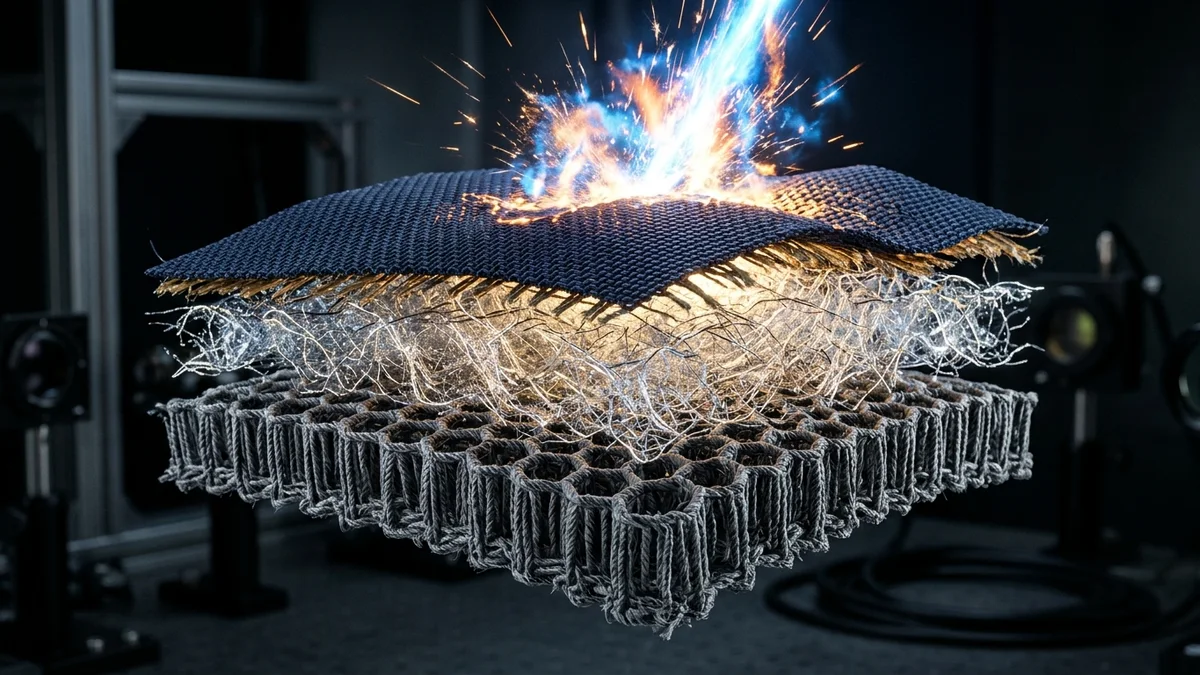
440 g/m² Dual-Layer Micro-Air-Gap Architecture
A 225 g/m² ripstop aramid outer shell (93% meta-aramid, 5% para-aramid, 2% antistatic) paired with a 215 g/m² thermal aramid inner liner achieves 40 cal/cm² ELIM with 35% lower mass than legacy kits.

Arc Defender 40 Ultralight Arc Flash Suit
Module B Certificate 26/10153/00/0161/B (Test Report 2026EP1005) by AITEX CE 0161 and Module D QA by Universal CE 2163: 440 g/m² dual-layer aramid rated to ELIM 40 / Fabric ATPV 49 cal/cm² and APC 2.
4. Complementary Standards & Hand Dielectric Safety Boundary
Arc flash incidents combine radiant plasma, convective flame, and electrostatic ignition risks, while technicians' hands operate 2–3× closer to energized conductors than their torso (1/r² inverse-square amplification). Your tender must cover the complete protective boundary.
- EN ISO 11612:2015 (A1+A2, B1, C1, F1): Verifies limited flame spread, convective heat, radiant heat, and contact heat attenuation.
- EN 1149-5:2018 Antistatic: 2% antistatic carbon-core fiber prevents electrostatic discharge in switchgear rooms and petrochemical substations.
- Hand Protection & EN 60903 Separation: The ArSafe APC 2 arc glove provides 125.3 cal/cm² dorsal and 28.1 cal/cm² palmar ATPV (ASTM F2675, EN 388 3112X, EN 407 4X2XXX), yet is strictly non-dielectric and never replaces EN 60903 electrical insulating rubber gloves.
- Hardware Integrity: Concealed storm-flap zippers, FR hook-and-loop closures, and meta/para-aramid sewing threads must leave zero exposed conductive metal.
5. Copy-Ready B2B Tender Specification Checklist (8 Mandatory Clauses)
Procurement and HSE leaders can insert the following eight accredited clauses directly into switchgear PPE tender documents to filter out non-compliant bids:
- Category III EU Compliance: Garments shall comply with Regulation (EU) 2016/425 Category III, backed by an active EU Type-Examination Certificate (Module B, e.g., AITEX CE 0161) and annual production QA surveillance certificate (Module D, e.g., Universal CE 2163).
- Open-Arc Verification (IEC 61482-1-1): Accredited laboratory reports shall verify minimum garment ELIM ≥ 40 cal/cm² (Garment ATPV ≥ 40 cal/cm², Standalone Fabric ATPV ≥ 49 cal/cm²).
- Enclosed Box Test (EN 61482-1-2): Complete garment assembly shall pass APC 2 (7 kA / 500 ms) without breakopen, melting, or Stoll burn threshold exceedance.
- Inherent Flame-Resistant Fiber: Fabrics shall be permanently inherent aramid (non-treated) with total dual-layer system mass ≤ 460 g/m² (e.g., 440 g/m²: 225 g/m² ripstop outer shell + 215 g/m² thermal aramid liner) to minimize heat stress.
- Multi-Norm Coverage: EN ISO 11612 (minimum A1+A2, B1, C1, F1) and EN 1149-5 electrostatic dissipation shall be listed on the same EU Type-Examination certificate.
- Ergonomic Trap-Free Design: Stand-up thermal collar, storm-flapped concealed closure, zero exposed conductive hardware, aramid thread seams, and FR retroreflective trim.
- Sizing & Traceability: Available in EN ISO 13688 sizes S (46/48) to XXL (62/64) with permanent lot/serial traceability, 4-digit Notified Body CE marking, and care labeling.
- System Pairing Protocol: Tender package shall align with GS-ET-29 Class 2 / 40 cal arc hood, ASTM F2675 / APC 2 arc gloves (dorsal ≥ 125.3 cal/cm²), and voltage-rated EN 60903 insulating gloves where live contact risk exists.
Frequently Asked Questions (FAQ)
Is specifying EN ISO 11612 alone enough to procure an electric arc flash suit?
What is the difference between FR-treated cotton and inherent aramid arc flash suits?
Which three documents must procurement verify for Category III arc PPE bids?
Request Accredited Certificates & Custom Tender Specifications
Contact our engineering desk directly for AITEX CE 0161 Module B type-examination reports, Universal CE 2163 Module D QA documentation, and project-ready B2B technical quotations.

