ARSAFE ELECTRIC ARC FLASH PROTECTIVE GLOVE

For hands that
command the grid.

ArSafe Electric Arc Flash Protective Glove

Engineered strictly for thermal protection against arc flash hazards. Tactile dexterity for operational mastery.

Dorsal ATPV (Back of Hand)
125.3 cal/cm²
Palmar ATPV (Palm)
28.1 cal/cm²
Biomechanical Grip Reality: At the instant of arc flash, the technician grips a hand tool; the palm is closed and geometrically shadowed by the tool body. The surface directly confronting the expanding arc plasma and radiant flux is the DORSAL ASPECT (125.3 cal/cm²).
Explore Arc Hazard & Engineering Details
ArSafe 360 Preview
0° — Dorsal Surface (125.3 cal/cm²)
PHYSICAL HAZARD DIFFERENTIATION

Instantaneous Arc. Severe Thermal Consequence.

The hazards threatening hands in electrical environments stem from fundamentally different physical mechanisms. Distinguishing electrical insulation from arc thermal defense is critical to lineworker survival.

125.3 cal/cm²

Extreme Radiant Heat & Plasma

High-energy thermal plasma and intense radiant heat flux released within milliseconds during an electrical arc flash event.

ArSafe Countermeasure: Polychloroprene para-aramid composite layer is non-melting, non-dripping, and blocks high-density thermal flux.
EN 388 Level 3

Molten Metal & Particle Shrapnel

Vaporized copper droplets exceeding 1,000°C ejected outward by busbar and conductor deflagration.

ArSafe Countermeasure: Substantial natural bovine leather and aramid structural seams provide an impenetrable barrier against molten metal splatter.
100% Aramid Thread

Acoustic Shock & Blast Pressure Wave

Violent mechanical pressure front resulting from the rapid volumetric expansion of superheated ambient air.

ArSafe Countermeasure: High-tensile para-aramid structural seams prevent catastrophic fabric rupture and seam separation.
EN 407 Level 4

Intense UV / IR Optical Radiation

Blinding optical arc flash emission accompanied by intense infrared radiation capable of inflicting deep tissue burns.

ArSafe Countermeasure: Opaque composite barrier absorbs and attenuates UV/IR radiation while eliminating afterglow and ignition.
BIOMECHANICAL GRIP REALITY & DESIGN PARADOX

Palm is Closed During Flashover: The Surface Directly Confronting Arc Radiation is the Dorsal Aspect!

Fundamental Physical & Biomechanical Reality: A lineworker operating inside switchgear, cubicles, or transformer kiosks firmly grips an insulated hand tool (wrench, screwdriver, pliers, voltage test probe). At the instant of arc initiation, the palm is physically CLOSED around the tool handle and geometrically shadowed by the tool body. The surface directly exposed to expanding arc plasma, molten copper splatter exceeding 1,000°C, and intense radiant heat flux is the DORSAL ASPECT (Back of Hand)!
The Fatal Flaw of Conventional Arc Gloves

Conventional Design Paradox

Most conventional "arc gloves" commit a critical design flaw by concentrating thermal padding solely on the palm, leaving the back of the hand completely vulnerable with minimal thermal resistance.

  • Unprotected Dorsal Surface: The dorsal aspect—directly impacted by radiant thermal flux—remains unprotected, subjecting lineworkers to catastrophic burn injuries.
  • Compromised Tactile Dexterity: Bulky padding lumped into the palm destroys hand dexterity, tool grip, and fastener tactile control, tempting workers to remove their PPE during live operations.
ArSafe Biomechanical Engineering

Engineered Defense: Correct Protection on the Correct Surface

ArSafe is purpose-built for this exact biomechanical reality: providing a massive 125.3 cal/cm² thermal shield on the dorsal aspect confronting direct radiant flux, paired with 28.1 cal/cm² supple top-grain leather on the tool-shielded palm for maximal dexterity and abrasion resistance.

  • 125.3 cal/cm² Dorsal Shield: Fully protects the back-of-hand directly facing arc plasma with a multi-layered polychloroprene-coated para-aramid composite armor.
  • 28.1 cal/cm² Natural Leather Palm: Provides exceptional tactile feel, friction grip, and mechanical control with supple bovine leather on the tool-shadowed palm.
REAL-WORLD FIELD EVENT // FORENSIC ENGINEERING ANALYSIS

Forensic Case Study: Low-Voltage Arc Flash Event and Dorsal Thermal Degradation Analysis

Empirical evidence demonstrating dorsal fabric rupture (break-open), biomechanical tool shielding of the palm, and severe dorsal burn trauma inflicted by conventional "palm-only" protective gloves during a 230/400V distribution fuse cut-out event.

Incident Environment 400V LV Distribution Cut-Out / NH Blade Fuse Enclosure
Thermal Plasma Flux > 10,000 °C Arc Core & Vaporized Copper Splatter
Biomechanical Posture Palm Tool-Shielded // Dorsal Perpendicular to Radiant Flux
Critical Failure & Outcome Dorsal Break-Open & Molten Polymer Dermal Adhesion

1. The "Low-Voltage Arc Myth" & Plasma Physics

The most lethal fallacy in electrical safety is assuming that 400V low voltage is thermally benign. Voltage determines only the dielectric breakdown required to initiate an arc; the resulting thermal incident energy is governed by available fault current, transformer kVA, and clearing time. Close to a distribution substation, LV prospective fault currents reach 15–25 kA. Plasma core temperatures exceed 10,000°C, vaporizing solid copper busbars within milliseconds and ejecting high-density thermal plasma directly onto hands at a lethal distance of 20–30 cm.

2. Biomechanical Shielding & Dorsal Break-Open Catastrophe

While working in switchgear, a lineworker grips an insulated fuse puller, wrench, or torque screwdriver. Fingers wrap firmly around the tool handle; the palm is physically closed and occluded by the tool shank. At the millisecond of flashover, the sole surface facing arc radiation and molten copper splatter at a 90° normal incidence is the DORSAL ASPECT (Back of Hand). In this examined specimen, the dorsal fabric charred instantly due to an inadequate thermal threshold, suffered catastrophic Break-Open (fabric rupture), and molten synthetic coating adhered to the skin, causing severe 2nd and 3rd degree burns.

3. The ArSafe 125.3 cal/cm² Para-Aramid Shield Advantage

Had this event been confronted with ArSafe APC 2: 1) The multi-layered polychloroprene-coated para-aramid dorsal shield guarantees zero Break-Open up to 125.3 cal/cm² ATPV, maintaining total barrier integrity and arresting plasma flux. 2) Certified under EN 407 Level 4 as 100% non-melting and non-dripping, the risk of molten polymer adhering to tissue is completely eliminated. 3) While 28.1 cal/cm² supple top-grain leather preserved flawless tool control on the shielded palm, the dorsal armor would have shielded the lineworker's hands without a single burn.

Forensic Case Comparison: Conventional Field Glove vs. ArSafe APC 2

Evaluated Case Parameter Conventional Glove Field Failure ArSafe APC 2 Engineering Countermeasure Engineering Safety Margin
Dorsal Aspect Thermal Resistance Minimal thermal capacity (~8–12 cal/cm²); incinerated instantly during 400V arc event 125.3 cal/cm² ATPV (ASTM F2675) & EN 61482-1-2 APC 2 (7 kA / 0.5 s) Over 10-Fold Safety Margin
Melting & Dripping Behavior Synthetic polymer coating melted, contracted, and fused with technician's dermal tissue 100% Non-melting, non-dripping para-aramid composite structure Zero Dermal Adhesion Risk
Thermal Break-Open Resistance Dorsal surface suffered massive tensile rupture, completely compromising the thermal barrier Maintains complete physical barrier integrity up to 125.3 cal/cm² without break-open Plasma Skin Contact Blocked
Biomechanical Protection Focus Dorsal aspect left vulnerable; surface directly confronting radiant flux was destroyed 125.3 cal/cm² shield confronting the arc, paired with 28.1 cal/cm² leather on the palm 100% Aligned with Grip Reality
Mechanical Seam & Thread Integrity Standard synthetic seams ruptured under acoustic shock and blast expansion pressure EN 388 (3112X) abrasion resistance assembled with 100% para-aramid thread Unbroken Envelope Cohesion
FIG-01 // INCIDENT SCENE

400V Distribution Cut-Out & Arc Plasma Soot

Forensic Case Inspection
FORENSIC FIELD OBSERVATION

Even under low voltage (400V), high prospective short-circuit current generated a violent plasma flash that charred the enclosure interior and adjacent masonry, embedding micronized molten copper particles into the surrounding surfaces.

ENGINEERING ROOT-CAUSE ANALYSIS

Electrical arc flash is governed by energy and distance, not voltage alone. At a nominal 400V grid level, an arcing fault across busbars generates dozens of cal/cm² of incident energy at the lineworker's working distance of 20–30 cm.

ARSAFE APC 2 PROTECTION ADVANTAGE

ArSafe absorbs this localized energy spike (governed by the IEEE 1584 hand distance multiplier) with 125.3 cal/cm² ATPV dorsal barrier protection; its non-melting, non-dripping structure shields lineworkers from burn injury.

Electrical Shock (Electrocution) Hazard

Physical contact with an energized conductor causing electric current to pass through the human body to ground or another phase. Preventing current flow through the worker is vital.

Mandatory Protection: EN 60903 / ASTM D120 Certified Dielectric Insulating Rubber Gloves

Electric Arc Flash (Thermal Blast) Hazard

Dielectric breakdown of air insulation generating instantaneous radiant heat flux, blinding optical flash, and high-energy expanding plasma.

Mandatory Protection: ArSafe Arc Thermal Protective Glove (ASTM F2675 / APC 2)
Operational Mode 1: Standalone Thermal Shield

De-Energized & Shock-Isolated Arc Scenarios

Employed as standalone primary thermal hand protection where electric shock hazard is eliminated or isolated, but severe arc flash potential persists (opening switchgear doors, racking circuit breakers, manual disconnect switching, and exterior inspection).

Operational Mode 2: Outer Protector Glove (OSHA 1910.269)

Dielectric Protector Layering Protocol

Worn over EN 60903 / ASTM D120 Class 00–2 dielectric rubber insulating gloves during energized operations where shock and arc hazards coexist. Vastly exceeds traditional leather protectors (ASTM F696) by delivering combined EN 388 mechanical defense and 125.3 cal/cm² dorsal arc thermal shielding.

DIELECTRIC COMPATIBILITY ARCHITECTURE

Dielectric Rubber Glove Class & Gauntlet Length Matrix

In strict adherence to ASTM F696 and OSHA 1910.269, a mandatory clear dielectric distance must be maintained between the outer protector cuff and the inner dielectric rubber glove bead based on working voltage:

30 cm Gauntlet Cuff (280–300 mm)

Paired seamlessly with EN 60903 / ASTM D120 Class 00 (500V) & Class 0 (1,000V) rubber insulating gloves. Fully satisfies the OSHA / ASTM minimum 13 mm (0.5 in) clear distance standard.

Recommended Application: Low-Voltage (LV) Distribution Switchboards, Meter Cubicles & Cut-Outs
40 cm Gauntlet Cuff (310–330 mm)

Paired with EN 60903 / ASTM D120 Class 1 (7,500V — min 25 mm gap) & Class 2 (17,000V — min 51 mm gap) gloves. Extends protection over the forearm against tracking and flashover.

Recommended Application: Medium-Voltage (MV) Switchgear Cubicles, Substations & Breaker Racking
ENGINEERING COMPARATIVE EVALUATION

Why ArSafe Two-Layer Modular Architecture Outperforms Single-Piece "Isoarc" Gloves

Comparative analysis based on international technical tender specifications evaluating monolithic "Isoarc" composite gloves against ArSafe's modular protection methodology:

Evaluation Metric Conventional Single-Piece Isoarc Gloves ArSafe Two-Layer Modular Architecture
Ergonomics & Tactile Dexterity Extremely rigid and bulky material; severely impairs small component assembly, terminal screw torqueing, and fine tool control. Ergonomic pre-curved cut with supple bovine leather palm; exceptional control over M4/M6 fasteners, terminal lugs, and calibration probes.
Arc Thermal Performance (ATPV) Constrained thermal thresholds (e.g., Class 00 Isoarc typically provides only ~21.6 cal/cm² across the entire envelope). Massive 125.3 cal/cm² dorsal barrier (APC 2) confronting arc plasma + balanced 28.1 cal/cm² palmar protection.
Mechanical Durability & Risk Highly susceptible to surface abrasion and punctures; any minor perforation immediately condemns the entire expensive unit. EN 388 Level 3 abrasion resistance; acts as a sacrificial barrier shielding expensive inner dielectric gloves from mechanical wear.
Total Cost of Ownership (TCO) Demands costly glove inventory for each voltage class; short service life and rapid replacement cycles. Significantly extends dielectric glove operational life; delivers maximum return on investment and reduced operational overhead.
IEEE 1584 ENGINEERING CALCULATION MODEL & INCIDENT ENERGY ANALYSIS

Thermal Protection Asymmetry in Utility Operations: IEEE 1584

Arc flash PPE selection must be grounded in IEEE 1584 distance physics: evaluating calculated incident energy at hand working distance (~250 mm) where thermal flux concentrates at 2.6x the torso level.

THERMAL PROTECTION ASYMMETRY & IEEE 1584 ANALYSIS

Thermal Protection Asymmetry in Utility Operations: Hand vs. Torso IEEE 1584 Analysis

Engineering Finding & Biomechanical Reality: Electric power distribution utilities routinely procure 30 cal/cm² or 40 cal/cm² arc-rated suits for the torso. However, lineworker hands operate 2.6 times closer to the arc flash source (~250 mm), concentrating an extreme 78 – 104 cal/cm² of incident thermal energy. Furthermore, the lineworker inevitably grips an insulated hand tool. At the instant of flashover, the palm is physically CLOSED around the handle and geometrically shadowed by the tool body; the surface directly confronting expanding plasma and radiant heat flux is the DORSAL ASPECT (Back of Hand)! ArSafe eliminates this severe safety asymmetry with its massive 125.3 cal/cm² dorsal protective shield.
Torso Protection Standard

Torso PPE Procurement Specifications

  • Working Distance (D): ~457 mm (18 in)
  • Standard Utility Tender Spec: 30 – 40 cal/cm²
  • Deployed Protective PPE: Arc-Rated Protective Suit / Coverall
  • Utility Procurement Status: Specified in Standard Tenders
Torso Evaluation: At the 457 mm reference working distance, 30–40 cal/cm² arc suits provide standard compliance against calculated torso incident energy.
Hand Exposure Analysis (IEEE 1584)

Hand Exposure at Task Point

  • Working Distance (D): ~250 mm (10 in — Point of operation)
  • Calculated Incident Energy (2.6x): 78 – 104 cal/cm²
  • Direct Exposure Surface: Dorsal Aspect (Confronting Arc)
  • Palmar Grip Posture: Tool-Shielded (Physically Occluded)
  • Thermal Protection Status: Dorsal 125.3 cal/cm² (Protected)
Biomechanical Exposure Dynamic: Due to proximity to the arc fault, 78–104 cal/cm² of incident energy directly impacts the back of the hand. With the palm closed around the tool handle, conventional gloves with palm-only padding leave lineworkers defenseless, whereas ArSafe's 125.3 cal/cm² dorsal barrier guarantees complete thermal containment.
IEEE 1584 Inverse-Square Law (Distance-Energy Relation) & Engineering Solution

Physical Law: Under IEEE 1584 arc flash calculation models, incident energy density is inversely proportional to working distance raised to an exponent (E ∝ 1/D^x; where x ≈ 1.5–2.2 for switchgear busbars). Reducing working distance from torso (457 mm) to hands (250 mm) causes incident energy density to escalate non-linearly by approximately 2.6 times.

Biomechanical Grip Reality: A lineworker executing energized tasks firmly grips an insulated hand tool. At the instant of arc initiation, the palm is physically CLOSED around the handle and geometrically shadowed by the tool body. The surface directly exposed to arc plasma and radiant flux is the DORSAL ASPECT (Back of Hand). ArSafe strategically positions its massive 125.3 cal/cm² shield precisely where arc energy strikes.

ArSafe Engineering Solution: ArSafe APC 2, with its 125.3 cal/cm² dorsal composite barrier (ASTM F2675 / Box Test APC 2), easily absorbs this 2.6x hand exposure (~78 cal/cm² in 30 cal/cm² utility environments, ~104 cal/cm² in 40 cal/cm² plants) with robust safety margins, completing the personal protective equipment chain.

INTERACTIVE ENGINEERING SIMULATOR

Hand Exposure vs. Torso Working Distance Simulator (IEEE 1584)

Incident energy escalates exponentially with decreasing distance (E ∝ 1/D^x). Select calculated torso incident energy (~457 mm) to evaluate corresponding hand exposure (~250 mm) and ArSafe's thermal protection margin:

Torso Incident Energy Presets:
Torso Incident Energy (457 mm) 8 cal/cm² Standard MCC / Category 2
Estimated Hand Exposure (250 mm) 20.8 cal/cm² 2.6x Hand Multiplier (20.8 cal/cm²)
Dorsal ATPV (Confronting Arc) 125,3 cal/cm² Safe Coverage (+502% Buffer)
Grip Posture & Mechanical Tool Control 28,1 cal/cm² Tool-Shielded (Occluded from Direct Radiation)
Engineering Assessment: At 8 cal/cm² torso exposure, hand incident energy reaches ~20.8 cal/cm². Standard MCC / switchgear compartment. While the tool-gripping palm remains shielded behind the tool handle, the dorsal aspect directly confronting arc plasma operates with a +502% safety buffer (125.3 cal/cm² ATPV).
1

Working Distance (D)

Hands are inevitably positioned closest to the arc fault during switching and racking. In addition to 457 mm or 610 mm torso calculations, safety assessments must account for hand exposure at 250 mm.

2

Clearing Time (t)

Arc duration depends directly on protection relay settings and breaker trip speed. Extended clearing times scale incident energy linearly; glove selection must align with actual fault clearing curves.

3

System Parameters & Enclosure Geometry

Prospective fault current, busbar gap, and enclosure boundary conditions determine plasma confinement and heat flux. High zonal ATPV must always be verified against site-specific risk calculations.

ArcSim Online Arc Risk Analysis

Model your busbar configuration and system parameters on the independent engineering platform based on IEEE 1584 and DGUV analytical models to evaluate calculated incident energy.

Launch ArcSim Consult on Risk Assessment Independent external engineering tool (arcsim.info) — Opens in new tab.
INDEPENDENT ACCREDITED LABORATORY PROOF // AITEX (SPAIN)

ASTM F2675 Open-Arc Ballistic Explosion Test: Official AITEX Laboratory Footage

High-speed optical recording and calorimeter sensor telemetry of ArSafe APC 2 during accredited open-arc blast testing at AITEX Textile Research Institute (Alcoy, Spain) per ASTM F2675 / F2675M.

REC // AITEX LAB-ES [VALENCIA] ASTM F2675 / F2675M-23 4K HIGH-SPEED BALLISTIC OPTICAL SENSORS (1000 FPS)
LAB VERDICT: ZERO BREAK-OPEN / NO MELTING / NO DRIPPING (PASS)
ArSafe Glove Undergoing ASTM F2675 Open-Arc Explosion Testing at AITEX Laboratory

Ballistic Arc Blast & Thermal Phase Sequence

0:00 — T=0.00s
Arc Inception & Dielectric Breakdown

Air dielectric insulation failure between high-current electrodes, triggering an instantaneous multi-kiloampere arc plasma blast.

0:04 — T+0.12s
Peak Thermal Flux & Copper Vapor Expansion

Extreme >10,000°C plasma core expansion, accompanied by dense radiant flux and high-velocity molten metal projection.

0:08 — T+0.50s
Thermal Shield Resilience & Acoustic Shockwave

Dorsal polychloroprene para-aramid composite arresting intense radiant heat and pressure wavefront without seam slippage or fabric breach.

0:15 — Post-Blast
Zero Break-Open, Zero Dripping Verification

Post-test physical audit confirming zero break-open, zero afterflame, zero melting or dripping onto calorimeter sensor substrates.

Accredited Facility AITEX (Spain) European Notified Body & ENAC Accredited High-Power Test Laboratory
Test Method Standard ASTM F2675 / F2675M Standard Test Method for Determining the Arc Rating of Hand Protective Products
Measured Dorsal ATPV 125.3 cal/cm² Polychloroprene Para-Aramid Composite Armor System
Physical Integrity Verdict Zero Break-Open 100% Non-Melting, Non-Dripping per ASTM F2675 & EN 407 Level 4 — PASS
HYBRID ENGINEERING ARCHITECTURE

Inspect Both Surfaces: Dual-Surface Thermal Architecture

While conventional gloves pack thick padding into the palm leaving the back-of-hand exposed, ArSafe is engineered for real-world tool-grip biomechanics: massive 125.3 cal/cm² thermal armor on the exposed dorsal aspect, paired with 28.1 cal/cm² natural bovine leather for tactile control on the tool-shielded palm.

ArSafe 360 Interactive Turntable Preview
0° — Dorsal Aspect (125.3 cal/cm² ATPV)
MATERIAL ARCHITECTURE

Material Architecture: Purpose-Engineered Surfaces

Three calibrated structural focal points balancing an impenetrable radiant thermal barrier with tactile natural leather grip.

Polychloroprene-coated para-aramid textile macro structure

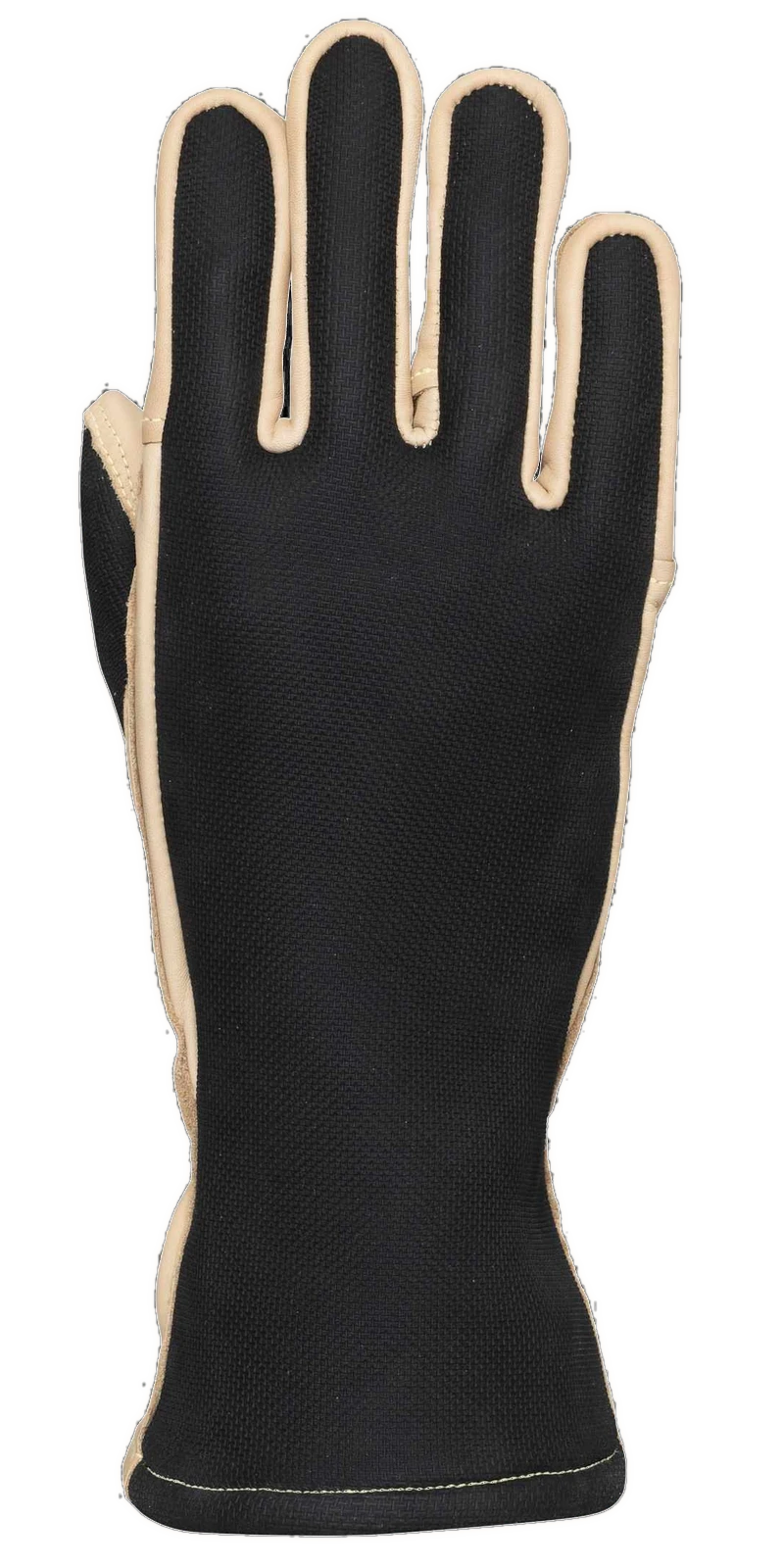
Dorsal Aspect: Para-Aramid Composite

High-density polychloroprene-coated para-aramid woven matrix. Non-melting, non-dripping, and flame-retardant under intense thermal flux.

Thermal Behavior Non-Melting / Non-Dripping
Dorsal ATPV 125.3 cal/cm²
Natural top-grain bovine leather palm surface

Palmar Aspect: Top-Grain Bovine Leather

Anatomically pre-curved natural leather contours. Engineered for rugged mechanical abrasion resistance, tactile sensitivity, and non-slip tool grip.

Abrasion Resistance (EN 388) Level 3
Palmar ATPV 28.1 cal/cm²
Protective gauntlet cuff and para-aramid seam architecture

Gauntlet Cuff & Aramid Seam Architecture

Overall length of 280–330 mm ensures seamless overlap with arc flash protective jackets and sleeves. 100% flame-retardant para-aramid stitching.

Structural Seams 100% Para-Aramid Thread
Total Length Range 280 – 330 mm
TACTILE DEXTERITY & MOTOR CONTROL

Precision in Every Detail. Flawless Tool Mastery.

Supple bovine leather palm and anatomically pre-curved contours accompany demanding energized tasks with unhindered precision.

Eliminates the dangerous temptation for lineworkers to remove their gloves when gripping small fasteners, torqueing terminal screws, or manipulating diagnostic test probes—keeping protection uninterrupted.

Anatomical Finger Coordination

Tactile sensitivity at the thumb and index fingertips enables effortless assembly of small nuts, terminal lugs, and delicate hardware.

Supple Leather Flexibility

Natural high-friction leather surface prevents tool slippage while minimizing hand and muscular fatigue during extended shifts.

Demonstration of fine tactile sensitivity gripping a small nut with ArSafe glove
OPERATIONAL CONTEXTS

Where Electrical Energy Commands the Grid.

From high prospective short-circuit utility substations to industrial motor control switchboards, engineered for high-risk operations.

HV / MV Distribution Grid

Power Utilities & MV/LV Substations

Switching maneuvers, racking circuit breakers, fuse cut-out replacement, and isolation operations with extreme arc flash exposure.

● Transformer kiosks & distribution switchgear
MCC & Heavy Industry

Industrial Maintenance & Motor Centers

Routine maintenance, troubleshooting, and thermographic inspections in heavy manufacturing distribution switchboards.

● Abrasion-resistant bovine leather grip
Assembly & Commissioning

Switchgear Testing & Commissioning

Confined terminal wiring, torque checks, and energized relay commissioning in high-density switchboards.

● Terminal block and fastener precision
BESS & Heavy DC Systems

EV & Battery Energy Storage (BESS)

Managing thermal runaway and DC arc flash hazards across high-voltage battery racks and DC fast-charging infrastructure.

● Comprehensive PPE integrity in DC arc scenarios
Emergency Response Crews

Rapid Fault Restoration & Field Repair

Overhead line restorations, storm-damage grid repair, and urgent feeder isolation in harsh all-weather environments.

● Extreme weather and field durability
Generation Facilities

Power Generation Plants

Hydroelectric, combined-cycle, wind, solar (PV), and cogeneration generator busbar and switchgear maintenance.

● High-power generator circuit breaker safety

Utility Grid Operational Validation Official Utility DSO Reference

ArSafe arc flash protective gloves are actively deployed across Turkey's major electrical distribution system operators, BEDAŞ and TREDAŞ. Trusted by thousands of lineworkers and switching operators during live network maintenance, breaker racking, and substation interventions, proving unmatched durability and thermal containment under real grid conditions.

⚡ BEDAŞ
⚡ TREDAŞ
Operational Context Notice: Task appropriateness is determined by site-specific risk assessment, operating procedures, and integrated PPE ensembles. Under the occupational health and safety hierarchy of controls, establishing an electrically safe work condition via lockout/tagout (LOTO) remains paramount.
TRANSPARENT & AUDITABLE DATA

Technical Evidence & Compliance Specifications

Our engineering approach provides complete transparency: publishing regional ATPV values, mechanical endurance, and thermal classifications with full standards context.

Technical Parameter Rated Performance Governing Standard
Dorsal ATPV 125,3 cal/cm² ASTM F2675/F2675M
Statistical arc thermal performance value based on the Stoll criterion (50% probability of second-degree burn onset) during ASTM F2675/F2675M open-arc testing.
Palmar ATPV 28,1 cal/cm² ASTM F2675/F2675M
Arc thermal performance value measured on the natural top-grain bovine leather palm under open-arc exposure.
Ar(Lim) Threshold 14 cal/cm² (Palmar Aspect) Manufacturer Stated
Threshold reported in manufacturer literature. Pending accredited test report verification, this must not be generalized as ELIM or an absolute zero-injury boundary.
Arc Protection Class (Box Test) APC 2 (7 kA / 0,5 s) EN 61482-1-2 / EN 61482-2
APC 2 box test classification (7 kA prospective fault current, 0.5 s duration). EN 61482-2 primarily governs garments; adaptation to hand PPE must be evaluated within test report context.
Mechanical Protection (EN 388) 3112X EN 388:2016+A1:2018
Abrasion: Level 3 | Circular blade cut: Level 1 | Tear: Level 1 | Puncture: Level 2 | ISO 13997 (TDM): X (Not tested). The letter X indicates no test was performed, not a failure.
Heat & Flame Performance (EN 407) 4X2XXX EN 407:2020
Limited flame spread: Level 4 | Contact heat: X | Convective heat: Level 2 | Radiant heat: X | Small molten metal splashes: X | Large quantities of molten metal: X.
Palmar Construction Premium top-grain bovine leather Natural Leather
Supple full-grain cowhide conforming to finger anatomy, delivering high friction grip, abrasion resistance, and tactile sensitivity.
Dorsal Construction Polychloroprene-coated para-aramid woven textile Technical Composite
High-density composite textile engineered as a thermal shield against intense radiant heat flux and instantaneous plasma deflagration.
Available Sizing Range 9 (S), 10 (M), 11 (L), 12 (XL), 13 (XXL) 5 Standard Sizes
Five standardized industrial sizes accommodating lineworker hand morphology across all operations.
Total Length Range 280 – 330 mm (30 cm & 40 cm Options) Protective Gauntlet
Gauntlet cuff designed to overlap arc protective sleeves without gap formation; 30 cm and 40 cm options available.
Notified Body Certification CE 0161 (AITEX — Spain / EU) EU Type-Examination
Tested, verified, and certified under European Union Notified Body 0161 (AITEX) in full compliance with Regulation (EU) 2016/425.
HS / Customs Tariff Code 4203.29.10 Customs Class
International Harmonized System tariff code for protective industrial leather work gloves.
General Protective Glove Standard EN ISO 21420:2020 AITEX 0161 Verified
General requirements for protective gloves: ergonomics, dexterity (Level 4), innocuousness (neutral pH, non-detectable Chromium VI), and sizing (AITEX CE 0161).
Weight, Packaging & Logistics ~200 g / pair • 40 Pairs / Carton Logistics & Supply
Standard shipping configuration: ~200 g nominal weight per pair, 40 pairs per export master carton (~9 kg gross), MOQ: 120 pairs (3 cartons), EXW Istanbul. OEM/White-label options available for qualified enterprise partners. Enclosed technical user manual.
Sewn-In Compliance Label PALM 28 cal/cm² | DORSAL 125 cal/cm² | APC 2 CE Permanent Label
Permanent compliance markings sewn into glove interior displaying open-arc and box-test performance data.
PPE Risk Classification Category III (Regulation (EU) 2016/425) CE 0161 Certified
Highest EU risk classification governing protection against mortal danger and irreversible harm; audited by AITEX CE 0161.
Dielectric Cuff Pairing 30 cm (Class 00/0) & 40 cm (Class 1/2) ASTM F696 & OSHA 1910.269
Optimized gauntlet lengths engineered for protective layering over EN 60903 / ASTM D120 Class 00–2 dielectric rubber gloves.
Dielectric Scope Disclaimer Thermal Arc Protection (Non-Dielectric) Critical Boundary
ArSafe is engineered strictly for thermal protection against arc flash hazards. It does NOT replace electrical insulating (dielectric) gloves per EN 60903 / ASTM D120 and does NOT prevent electric shock.
MECHANICAL ENDURANCE PERFORMANCE

EN 388:2016+A1:2018

3112X

Accredited breakdown of the natural bovine leather palm under mechanical endurance testing:

Abrasion Resistance (Abrasion) Level 3 / 4 (High)
Circular Blade Cut Resistance Level 1 / 5
Tear Resistance (Tear) Level 1 / 4
Puncture Resistance (Puncture) Level 2 / 4 (Balanced)
ISO 13997 Cut Resistance (TDM) X (Not Tested)
HEAT & FLAME PERFORMANCE

EN 407:2020

4X2XXX

Accredited breakdown of para-aramid composite and natural leather under flame testing:

Limited Flame Spread Level 4 / 4 (Maximum)
Contact Heat X (Excluded for arc focus)
Convective Heat Transfer Level 2 / 4 (Effective)
Radiant Heat X (Evaluated via ASTM F2675)
Small / Large Molten Metal Splatter X / X (Non-foundry standard)
PUBLIC TENDER & PROCUREMENT BENCHMARK

Corporate Procurement & Tender Specification Template

Verified engineering clauses ready for immediate inclusion into corporate EHS dossiers, public DSO utility tenders, and industrial procurement documents:

1. Test Methodology and Open-Arc Standard: Protective gloves shall be tested and certified in strict accordance with ASTM F2675 / F2675M (Standard Test Method for Determining Arc Ratings of Hand Protective Products). The dorsal (back-of-hand) Arc Thermal Performance Value (ATPV) shall be at least 120 cal/cm² (with an authoritative target of 125.3 cal/cm²). The palmar ATPV shall be at least 25 cal/cm² (target: 28.1 cal/cm²), engineered to preserve operational dexterity without compromising thermal safety.
2. Directed Arc Box Test Classification: The glove shall meet or exceed Arc Protection Class 2 (APC 2) per EN 61482-1-2 / IEC 61482-1-2 box test methodology under a prospective short-circuit current of 7 kA with an arc duration of 0.5 seconds.
3. Material Architecture & Thread Integrity: The dorsal aspect shall be fabricated from a polychloroprene-coated para-aramid technical composite textile engineered for non-melting, non-dripping performance under high radiant heat flux and instantaneous plasma exposure. The palmar aspect shall be constructed from premium top-grain bovine leather pre-curved for ergonomic tool control. All structural seams shall be assembled using 100% flame-resistant para-aramid industrial thread.
4. Mechanical & Thermal Performance Classifications: The glove envelope shall achieve at least 3112X under EN 388:2016+A1:2018 (Abrasion Level 3, Cut Level 1, Tear Level 1, Puncture Level 2, ISO Cut X) and at least 4X2XXX under EN 407:2020 (Limited Flame Spread Level 4, Convective Heat Level 2).
5. Regulatory Compliance & Category III Certification: The product shall be classified as Category III Personal Protective Equipment under Regulation (EU) 2016/425 (complex design against mortal danger and irreversible harm) and shall possess a valid EU Type-Examination Certificate issued by an accredited European Notified Body (AITEX CE 0161). An official EU Declaration of Conformity (DoC) and comprehensive user instructions shall accompany all deliveries.
6. Dielectric Compatibility & Sizing Range: The glove shall be fully compatible as an outer protective layer over EN 60903 / ASTM D120 Class 00, 0, 1, and 2 dielectric rubber insulating gloves per OSHA 1910.269 guidelines. The product line shall offer at least five standardized sizes: 9 (S), 10 (M), 11 (L), 12 (XL), and 13 (XXL), available in gauntlet cuff lengths of 30 cm (for Class 00/0) and 40 cm (for Class 1/2).
7. Utility Grid Compliance & Field Evaluation Samples: The glove shall satisfy all technical evaluation criteria established by major electrical distribution system operators (DSOs) and transmission authorities. The supplier shall provide certified test certificates and evaluation sample pairs upon request for corporate EHS technical review.
OFFICIAL COMPLIANCE & DOCUMENTATION LIBRARY

Technical Documentation & Compliance Library

Directly inspect or download verified engineering data sheets and CE Type-Approval marking sheet prepared by manufacturer BundleTec.

🇬🇧 EN • English PDF • 263 KB

ARSafe Technical Data Sheet (TDS — EN)

Official international engineering data sheet. Details ASTM F2675/F2675M open-arc ratings, comparative evaluation against ASTM F696 leather protectors, dielectric layering compatibility, and gauntlet sizing.

  • ASTM F2675 Open-Arc ATPV Ratings (125.3 / 28.1 cal/cm²)
  • Official Hand Circumference & Length Sizing Matrix (Sizes 9–13)
  • ASTM F696 Beyond Protective Intent & OSHA 1910.269
  • Customs Tariff Number (HS Code): 4203.29.10
🌐 CE • Label PDF • 26.4 KB

ArSafe CE Type-Approval Marking & Labeling Specification

Permanent compliance label specification. Displays Palm ATPV 28 cal/cm², Dorsal ATPV 125 cal/cm², and EN 61482-1-2 APC 2 box test pictograms.

  • Dorsal ATPV: 125 cal/cm² permanent identification marking
  • Palmar ATPV: 28 cal/cm² permanent identification marking
  • EN 61482-1-2: APC 2 Box Test official norm pictogram
  • AITEX CE 0161 Notified Body conformity reference
ERGONOMICS & SERVICE LIFE

Sizing Precision & Maintenance Protocol

A properly fitted arc glove eliminates hazardous air pockets while delivering uncompromised dexterity during fine hardware assembly and energized switching.

Interactive Sizing Selector & Dimensions

Measure the circumference of your dominant palm (excluding thumb) with a flexible tape; select your size below:

ArSafe Sizing Guide: A Palm Circumference and B Total Length A: Palm Circumference B: Length

How to Measure Your Hand

  1. A (Palm Circumference): Wrap a flexible measuring tape around your palm just above the base of your thumb.
  2. B (Total Length): Total length engineered to overlap wrist and arc flash protective sleeves.
  3. Recommendation: When worn as an outer protector over rubber insulating gloves, consider selecting one size larger to ensure easy donning.
Palm Circumference: 230 mm
Total Length: 300 mm
User Morphology: Medium / Standard lineworker hands
Size Euro Label Palm Circumference Total Length Morphological Profile
9 S 220 mm 280 mm Small / Medium hand morphology
10 M 230 mm 300 mm Medium / Standard lineworker hands
11 L 240 mm 320 mm Large hands / Dielectric under-layering
12 XL 250 mm 310 mm Broad palmar anatomy
13 XXL 260 mm 330 mm Extra-large hand anatomy
Technical Note: Published manufacturer data records overall lengths for sizes 11 and 12 as 320 mm and 310 mm respectively; values are presented without arbitrary interpolation. In the field, metacarpal palm circumference remains the primary sizing datum.
💡 Selected size is automatically transferred to the briefing request form below.

Maintenance & Handling Protocol

Storage Protocol

Store gloves in their original packaging in a clean, dry, and well-ventilated space, shielded from direct sunlight (UV), ozone sources, and excessive humidity.

Cleaning & Care Directives

Do not machine wash, bleach, tumble dry, iron, or dry-clean. Light surface dirt should be removed gently using a damp microfiber cloth, followed by natural air drying at room temperature.

Mandatory Pre-Use Inspection

Inspect thoroughly before every energized task for seam separation, leather punctures, oil contamination, or chemical degradation. Immediately decommission any PPE with compromised integrity.

Customs Code (HS / GTIP) 4203.29.10
Unit Weight / Pair ~200 g / Pair
Packaging Standard 40 Pairs / Carton (~9 kg)
Gauntlet Cuff Options 30 cm & 40 cm Lengths
Origin & Logistics EXW Istanbul, Turkey
FREQUENTLY ASKED QUESTIONS

Technical Engineering Inquiries & Answers

Authoritative engineering answers regarding standards compliance, dielectric scope, and operational field procedures.

What is the fundamental difference between an electric arc flash glove and an electrical insulating glove?
These two protective devices address fundamentally distinct physical phenomena. Electrical insulating gloves (certified to EN 60903 or ASTM D120) are manufactured from dielectric rubber designed to prevent electric current from flowing through the wearer's body. Conversely, the ArSafe electric arc protective glove is engineered to protect hands against the extreme radiant heat flux, optical radiation, and expanding plasma blast generated by an arc flash. Does not replace electrical insulating (dielectric) gloves per EN 60903 / ASTM D120; for live energized work, it must be integrated with certified dielectric systems matching system voltage.
Why are separate ATPV ratings published for the dorsal aspect (125.3 cal/cm²) and the palmar aspect (28.1 cal/cm²)?
This dual-rating reflects fundamental biomechanical reality during energized electrical operations. A technician operating inside switchboards or fuse cut-outs grips an insulated hand tool (ratchet, screwdriver, fuse puller, test probe). At the critical instant of arc initiation, the palm is physically closed around the tool handle, geometrically occluded and shielded from direct plasma irradiation. The surface directly exposed to incident radiant heat flux and expanding plasma is the DORSAL (Back-of-Hand) aspect. Many commercial gloves place excessive protection on the palm while leaving the back-of-hand vulnerable. ArSafe resolves this paradox: it deploys a 125.3 cal/cm² polychloroprene para-aramid thermal shield directly confronting the arc on the back of the hand, while preserving tactile dexterity and mechanical durability with 28.1 cal/cm² supple bovine leather on the tool-shielded palm.
What does the ATPV (Arc Thermal Performance Value) metric represent under ASTM F2675?
ATPV (Arc Thermal Performance Value) is defined under ASTM F2675/F2675M-23 as the incident energy density (expressed in cal/cm²) on a material that results in a 50% statistical probability of heat transfer sufficient to cause the onset of a second-degree skin burn (based on the Stoll criterion). ATPV represents a standardized laboratory performance benchmark, not an absolute guarantee of zero injury. Electrical safety engineering mandates that calculated incident energy at the working distance must always remain safely below the PPE's rated ATPV.
Can Box Test (APC) ratings and Open-Arc ATPV values be mathematically converted into one another?
No. These two metrics stem from fundamentally different test methodologies and cannot be directly converted. Arc Protection Class (APC), defined in EN 61482-1-2 / IEC 61482-1-2 (Box Test), subjects PPE to a directed arc in an enclosed box under fixed prospective short-circuit parameters (APC 2 corresponds to 7 kA at 0.5 seconds). Conversely, ASTM F2675 open-arc testing delivers an unconstrained arc blast across a range of energy levels to determine a continuous numerical threshold in cal/cm² (ATPV). Both ratings provide vital, complementary safety data within their respective standard frameworks.
How can engineering and procurement teams access accredited test reports and compliance files?
Complete documentation can be downloaded directly from our Technical Documentation Library, including the English TDS (263 KB) and CE Type Marking Sheet (26 KB). For accredited third-party laboratory test certificates, tender compliance matrices, or site demonstration samples, please submit the Technical Briefing Request form on this page to connect directly with our engineering team.
How should field operations managers determine proper glove sizing for their crews?
ArSafe is manufactured in five standardized sizes: 9 (S), 10 (M), 11 (L), 12 (XL), and 13 (XXL). Proper sizing is determined by measuring the circumference of the dominant hand at the widest point of the palm (excluding the thumb) using a flexible measuring tape. A properly fitted glove eliminates air pockets that could compromise thermal insulation while ensuring optimal tactile sensitivity when handling terminal lugs and calibration hardware.
How should the ArSafe glove be integrated into a comprehensive site PPE program?
In accordance with the hierarchy of controls (NFPA 70E, IEEE 1584, EN 50110), establishing an electrically safe work condition through de-energization, lockout/tagout (LOTO), and verification of zero voltage remains the primary safety defense. Where energized interaction or live testing is unavoidable, incident energy at the technician's working distance must be calculated using engineering tools such as ArcSim or IEEE 1584 software. ArSafe gloves must then be integrated with matching arc-rated face shields, balaclavas, and arc flash suits to form an unbroken thermal protection envelope.
Is ArSafe compliant with OSHA 1910.269 as an outer protective glove worn over dielectric rubber gloves?
Yes. OSHA 1910.269 mandates the use of outer protector gloves over dielectric rubber insulating gloves. Traditional leather protectors (ASTM F696) provide only mechanical cut and puncture resistance without verified arc thermal attenuation. ArSafe significantly exceeds the intent of ASTM F696: it provides robust EN 388 (3112X) mechanical protection while adding massive arc thermal ratings of 125.3 cal/cm² on the dorsal aspect and 28.1 cal/cm² on the palm. It is fully compatible with Class 00, 0, 1, and 2 dielectric rubber gloves.
Why does the ArSafe two-layer modular system outperform single-piece 'Isoarc' composite gloves?
Single-piece "Isoarc" gloves attempt to combine dielectric insulation and arc flash protection into a single, thick rubber/composite shell. This results in extreme stiffness, severely impairing hand dexterity, tool handling, and fine motor control. Furthermore, any minor mechanical cut or surface puncture immediately condemns the entire expensive glove, and their arc ratings are typically modest (~21.6 cal/cm² for Class 00). The ArSafe two-layer modular architecture separates dielectric insulation (standard rubber glove) from thermal/mechanical protection (ArSafe outer glove), delivering superior ergonomic dexterity, 125.3 cal/cm² dorsal thermal defense, sacrificial mechanical protection for the dielectric glove, and substantially lower total cost of ownership (TCO).
TECHNICAL BRIEFING & PROCUREMENT

Technical Consultation & Enterprise Procurement

Contact our electrical safety engineering team directly for tender specification alignment, technical dossiers, and evaluation sample requests.

Manufacturer & Engineering Liaison

ArSafe electric arc flash protective gloves are manufactured in Turkey and deployed worldwide under verified international standards.

Transparency Principle: This portal does not conduct direct retail e-commerce. For corporate bulk purchases or unit orders, please proceed through our authorized distribution channel Teknik Ekipman.

Technical Briefing & Sample Request

Upon submission, your technical request draft will open in your default email client populated with your parameters.